RPE Calculator helps lifters estimate one-rep max, reps in reserve, training intensity, fatigue score, and next-set targets using RPE, reps, and load. Designed for strength training, hypertrophy planning, and session-to-session load adjustments with clear, data-focused results.
An RPE Calculator is an advanced analytical tool designed to help athletes and coaches accurately evaluate strength performance based on perceived exertion. Unlike traditional percentage-based programming that assumes an athlete’s max strength is static day-to-day, using an RPE Calculator allows lifters to auto-regulate their training based on current readiness and daily fluctuations.
By taking basic inputs—the weight lifted, the number of reps completed, your current RPE, and your target RPE for the next set—the system programmatically estimates a suite of essential training metrics. The outputs you see generated in the UI include an accurate 1RM estimate, specific daily training zones, fatigue scores, and precise load targets for your upcoming sets. Operating as a comprehensive strength training intensity calculator, this tool bridges the gap between subjective lifting effort and objective mathematical programming.
What Is RPE in Strength Training?
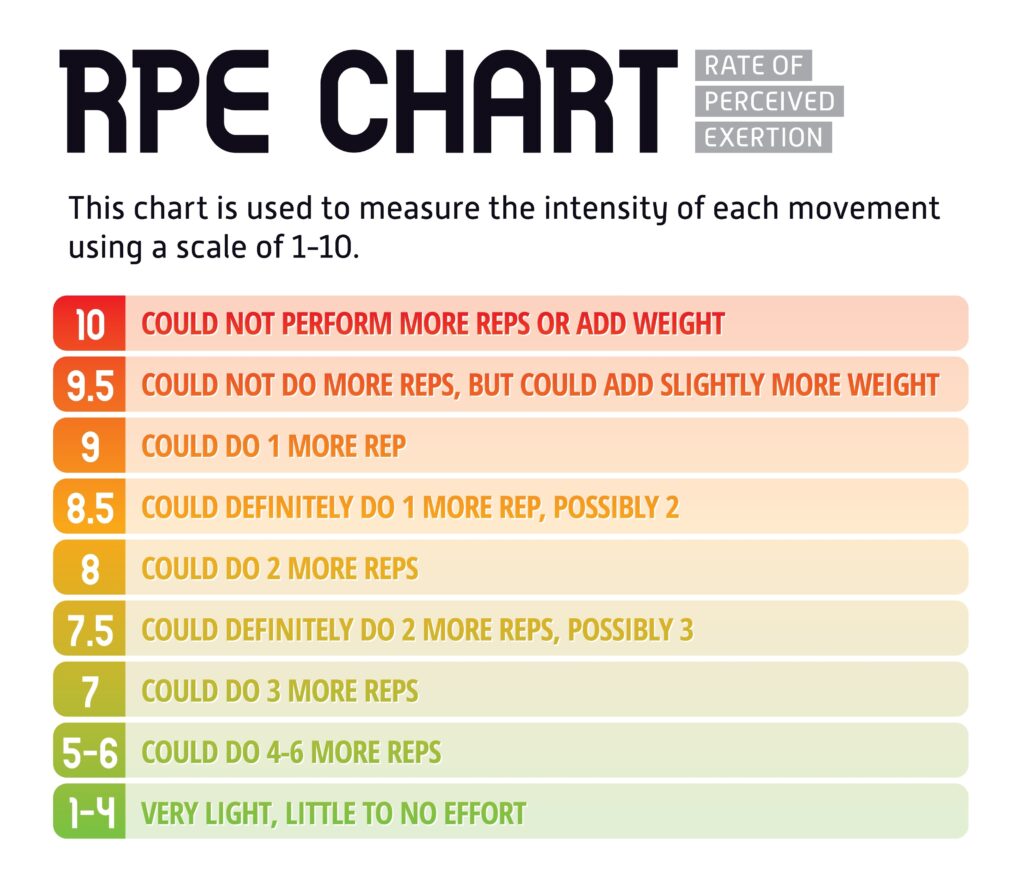
The Rate of Perceived Exertion (RPE) scale is a subjective measurement system used to quantify how difficult a set feels. In modern weightlifting, the scale typically runs from 6 to 10. By standardizing the feeling of a lift, athletes can mathematically translate subjective effort into actionable data.
The core relationship relies on the formula:
$$RIR = 10 – RPE$$
This equation demonstrates that your perceived exertion correlates directly to the repetitions you could have continued to lift. Regulating intensity through this method is highly effective because it adjusts automatically to fatigue, sleep quality, and physiological readiness, unlike rigid percentage matrices.
| RPE | Reps in Reserve | Effort |
| 6 | 4 RIR | Warm-up |
| 7 | 3 RIR | Fast reps |
| 8 | 2 RIR | Challenging |
| 9 | 1 RIR | Near max |
| 10 | 0 RIR | Failure |
How the RPE Calculator Estimates Your One-Rep Max
Estimating a maximum lift without actually performing a grinding, one-rep attempt is a primary function of a modern one rep max calculator. To achieve this, our system employs a modified Epley equation that factors in your perceived exertion rather than just the reps completed.
First, the system determines how many total reps you could have performed:
$$RIR = 10 – RPE$$
$$PotentialReps = Reps + RIR$$
Next, it applies the RPE 1RM formula to calculate the absolute max:
$$1RM = Weight \times \left(1 + \frac{PotentialReps}{30}\right)$$
This methodology yields highly accurate predictions for submaximal sets. By calculating the theoretical limit based on the “Potential Reps” ceiling, the calculator ensures that a 5-rep set taken to an RPE 8 outputs the exact same 1RM projection as a 7-rep set taken to absolute failure (RPE 10).
Understanding Reps in Reserve (RIR)
Reps in Reserve (RIR) defines the absolute distance between your current state at the end of a set and total muscular failure. When utilizing a reps in reserve calculator, you are translating a feeling into a hard, numerical limit.
The fundamental calculation is straightforward:
$$RIR = 10 – RPE$$
In practical terms, hitting an RPE 8 means you have exactly 2 reps left before the bar stops moving. An RPE 9 indicates exactly 1 rep left in the tank. Understanding this conversion is critical for managing systemic fatigue. Pushing every set to a 0 RIR (RPE 10) creates exponential fatigue debt, whereas maintaining a 2 RIR keeps the lifter in a sustainable progression curve while still applying enough stimulus to force adaptation.
How the Calculator Predicts Rep Max Strength Levels
Beyond a single max attempt, athletes need to know their working limits for varying rep ranges. The UI immediately displays your 3 Rep Max (3RM), 5 Rep Max (5RM), and 8 Rep Max (8RM) based on the dynamic percentage derived from your daily 1RM.
The background logic uses inverted variations of the modified Epley equation:
$$3RM = \frac{1RM}{1 + \frac{3}{30}}$$
$$5RM = \frac{1RM}{1 + \frac{5}{30}}$$
$$8RM = \frac{1RM}{1 + \frac{8}{30}}$$
Providing these specific breakpoints allows lifters to accurately plan their programming blocks. A coach can immediately look at the 3RM output to plan a heavy peaking phase or reference the 8RM output when shifting into a volume accumulation cycle, all without requiring the athlete to perform physical testing.
Training Intensity Zones Calculated From Your 1RM
To categorize the mechanical and physiological stimulus of your current strength level, the RPE Calculator fragments your estimated max into three distinct training blocks.
The heavy Strength zone targets maximal force output and neurological efficiency:
$$85\% – 100\% \times 1RM$$
The hypertrophy training zones are optimal for accumulating the volume needed for muscle cross-sectional growth:
$$70\% – 85\% \times 1RM$$
The Speed/Power zone is utilized for dynamic effort, focusing on acceleration and rate of force development:
$$50\% – 70\% \times 1RM$$
Segmenting the data this way gives athletes immediate context. If the UI shows your recent lift falls into the 75% range, you instantly know you are accumulating hypertrophy stimulus rather than peaking maximal force.
How the Calculator Predicts Your Next Set Load
A highly requested feature of a load progression calculator is the ability to prescribe the exact weight to put on the bar for a subsequent set. If you just performed 100kg for 5 reps at RPE 7, but your coach wants your next set to be an RPE 9, the tool calculates the precise load required.
It first isolates the target reserve capacity:
$$NextRIR = 10 – TargetRPE$$
Then, it recalculates the prescribed weight using your active 1RM:
$$NextLoad = \frac{1RM}{1 + \frac{(Reps + NextRIR)}{30}}$$
Executing this logic perfectly auto-regulates the session. If your daily 1RM is trending down due to poor sleep, the “Next Load” output will automatically suggest a lighter weight to hit your target RPE, keeping the physiological stimulus exactly where it needs to be.
Estimating Training Volume and Tonnage
Work capacity and total workload are primary drivers of muscular growth. Acting as a lightweight training volume calculator, the tool estimates the tonnage of your upcoming working sets to help gauge session difficulty.
The mathematical formulation for standard workload is:
$$Volume = Load \times Reps \times Sets$$
For example, if the tool prescribes 3 sets of 5 reps at 100 kg:
$$Volume = 100 \times 5 \times 3 = 1500$$
Tracking total volume dictates the hypertrophy stimulus. Evaluating the “Tonnage” output helps lifters understand if they are progressing structurally over time, even if their top-end 1RM is temporarily stagnant.
Fatigue Score and Load Stress Index Explained
Every repetition induces a specific amount of central and peripheral fatigue. To quantify this, the RPE Calculator assigns a ‘Fatigue Score’ output bucket (Low, Medium, or High) visible on the main dashboard.
The system derives this index using the following formula:
$$FatigueScore = RPE \times Reps \times \left(\frac{Weight}{1RM}\right)$$
The interpretation logic triggers a “Low” bucket rating for scores under 20, “Medium” for 20 to 40, and “High” for anything exceeding 40. By monitoring this specific UI metric, lifters can accurately dictate their recovery timelines. A session resulting in a High Fatigue Score indicates that the athlete will likely need an extra 24-48 hours before exposing the central nervous system to heavy loads again.
Neural Demand and CNS Activation
Heavy compound lifting requires immense output from the central nervous system (CNS). The RPE Calculator assesses this biological tax and provides a specific “Neural Demand” rating.
The underlying calculation tracks neural drive relative to maximum output:
$$Drive = \frac{Percent1RM}{10}$$
The UI will flag CNS stress as “High” when two specific conditions are met simultaneously:
- The load is $\geq 85\%$ of the 1RM.
- The exertion rate is $\geq 8$ RPE.
Understanding when neural demand peaks is vital for preventing overtraining. While muscles can recover from high-volume sets relatively quickly, the CNS requires extended recovery periods after high-drive, high-RPE exposures.
Example Calculation Using the RPE Calculator
To understand the backend architecture of this RPE weight calculator, we can walk through a manual evaluation of a standard lifter’s input data.
Assume an athlete inputs:
- Weight = $100\,kg$
- Reps = $5$
- RPE = $8$
Step-by-step mathematical execution:
$$RIR = 10 – 8 = 2$$
$$PotentialReps = 5 + 2 = 7$$
$$1RM = 100 \times \left(1 + \frac{7}{30}\right)$$
$$1RM = 123.3\,kg$$
Upon processing this math, the UI populates the main dashboard. The user sees their daily max estimated at 123.3 kg, a “Moderate” breakdown risk due to the 8 RPE, and a “High” confidence score because low-rep, high-RPE inputs yield the most accurate Epley estimations.
When Lifters Should Use an RPE Calculator
Different phases of training require different analytical tools. Powerlifting programming relies heavily on an RPE Calculator during peaking cycles to ensure athletes are not overshooting their intended effort levels weeks before a meet.
Conversely, during hypertrophy training blocks, tracking exertion prevents junk volume. Utilizing auto-regulated training principles ensures that lifters are adjusting their working weights up or down based on genuine capability that day, allowing for superior fatigue management and more consistent long-term results.
Advantages of RPE-Based Strength Programming
Moving away from fixed percentages toward the powerlifting RPE scale offers significant physiological benefits. Primarily, it adapts instantly to daily strength fluctuations. If you are dehydrated or under-slept, a fixed 85% might feel like 95%, leading to form breakdown.
Furthermore, this dynamic programming style reduces overall overtraining risks while drastically improving progression accuracy. By analyzing your session through an RPE Calculator, you ensure that the load on the bar precisely matches your biological capacity at that exact moment, yielding better fatigue management and safer lifting mechanics.
Frequently Asked Questions
What does RPE 8 mean in weightlifting?
An RPE 8 indicates a challenging set where the lifter has exactly two repetitions left in reserve before reaching muscular failure. It is the sweet spot for strength training, offering a high enough intensity to force neuromuscular adaptation while leaving enough energy in the tank to avoid excessive central nervous system burnout.
Can RPE replace percentage-based training?
Yes, and many elite powerlifters use it exclusively. While percentage-based training assumes your max is static, utilizing an RPE Calculator enables auto-regulation. It adjusts your prescribed weights up or down depending on your actual physical readiness on any given training day, preventing overreaching.
What RPE should hypertrophy sets use?
For optimal muscle growth, hypertrophy sets should generally fall between RPE 7 and RPE 9. This ensures you are training close enough to failure to recruit maximum muscle fibers, but stopping just short of total failure to allow for enough training volume and adequate systemic recovery.
Is RPE useful for beginners?
Beginners often struggle with subjective ratings because they have not yet experienced true muscular failure. It is usually recommended that novices use linear progression first. Once they understand their bodily limits, introducing an RPE Calculator helps them fine-tune their intermediate and advanced programming cycles.
How do you convert RPE to reps in reserve?
The conversion requires a simple subtraction formula: $RIR = 10 – RPE$. For instance, if you finish a heavy squat and rate the exertion as an RPE 7.5, you are stating mathematically that you could have performed exactly 2.5 more repetitions before completely failing the lift.
Can RPE predict fatigue?
Absolutely. The calculator assigns a specific load stress index by multiplying your exertion rate, volume, and percentage of your estimated 1RM. Consistently training at RPE 9 and 10 results in high fatigue scores, warning the lifter that they are accumulating central nervous system fatigue and need an upcoming deload phase.
Related Tools & Calculators:
[auto_calc_only cat=”fitness-body-tools” limit=”9″]