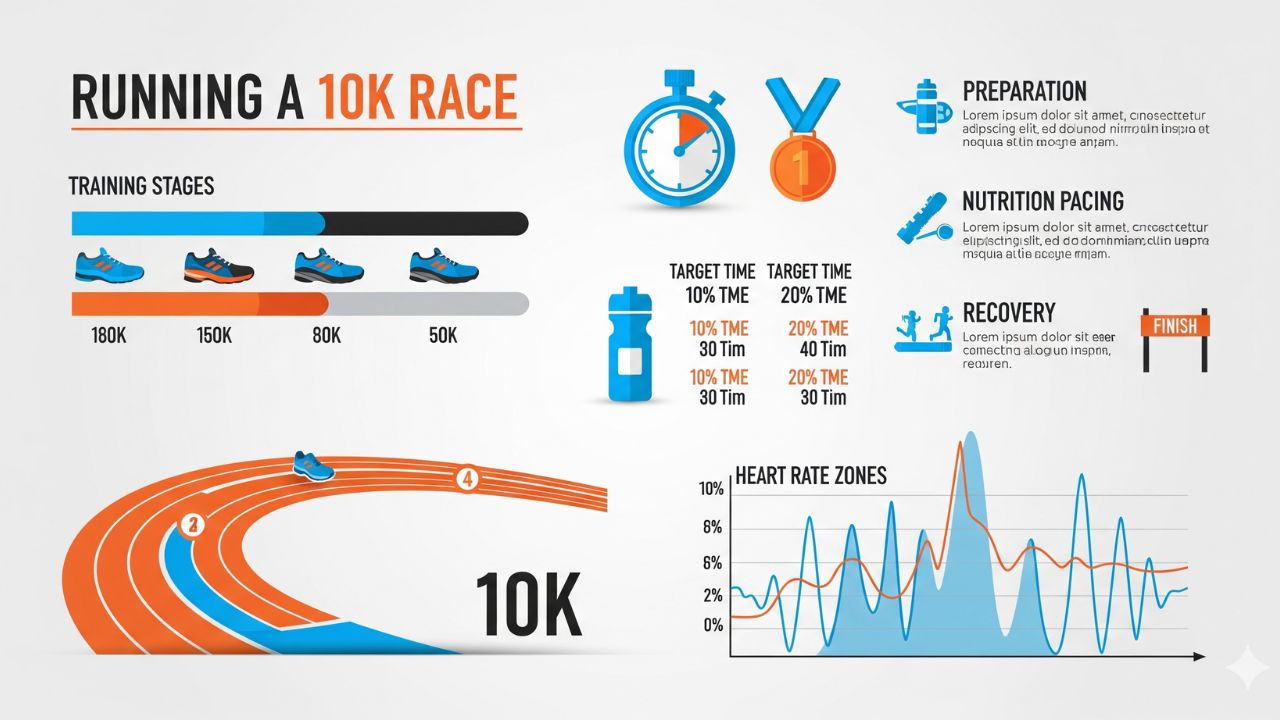
Stepping up to the 10K is one of the most exciting milestones in a runner’s journey. At exactly $10 \text{ kilometers}$ (or $6.21371 \text{ miles}$), the 10K is a fascinating physiological puzzle. It demands the aggressive turnover and speed of a 5K, blended perfectly with the sustained endurance required for a half marathon.
Many first-time 10K runners fail to reach their true potential because they select their finish-time goals based on arbitrary round numbers. The most common culprit is the desire to break the $60\text{-minute}$ barrier. While sub-60 is a fantastic achievement, pulling a goal out of thin air forces your body into a pacing strategy it may not be trained for, leading to burnout, heavy legs, and a miserable final two miles.
To run your best race, your goal needs to be rooted in your current fitness reality. By understanding the underlying math of race pace calculators and mapping those outputs to your daily training, you can set a realistic, challenging, and achievable target.
Understanding the Demands of the Distance
Before you can set a target time, you need to understand what the distance actually requires of your body. A 10K race is primarily an aerobic event. You are running on the razor’s edge of your lactate threshold—the point at which your body produces lactic acid faster than it can clear it.
If you run too fast in the early miles, you cross that threshold prematurely. Your blood becomes acidic, your muscles stop firing efficiently, and your pace drops off a cliff. This is why accurate pacing is your ultimate weapon.
Behind every digital pace calculator is a core mathematical relationship between time and distance: $$\text{Average Pace} = \frac{\text{Total Time}}{\text{Total Distance}}$$
For example, if your goal is to finish in exactly $60 \text{ minutes}$, the pace calculator determines your required speed like this: $$\text{Metric Pace} = \frac{60 \text{ minutes}}{10 \text{ km}} = 6:00 \text{ min/km}$$ $$\text{Imperial Pace} = \frac{60 \text{ minutes}}{6.21371 \text{ miles}} \approx 9:39 \text{ min/mile}$$
Your ultimate goal is to find the exact pace output that you can sustain smoothly for $6.2 \text{ miles}$ without crossing your lactate threshold until the final sprint to the finish line.
Establishing Your Current Fitness Baseline
You cannot accurately predict a finish time without hard data on your current fitness level. Relying on what you ran in high school, or what a local running group averages, will throw off your calculations. You need to establish a current baseline to feed into your pace predictions.
The 5K Time Trial
The most reliable predictor for a 10K is a recent 5K race or time trial. If you do not have a recent race result, you need to run a test. Find a flat, uninterrupted route—a local running track is ideal. Warm up with $$10 \text{ to } 15 \text{ minutes}$$ of light jogging and dynamic stretches. Then, run exactly $$5 \text{ kilometers}$$ at the hardest, most consistent effort you can safely sustain.
Do not sprint the first lap and walk the rest. You want an even, hard effort. Record your exact finish time. This number is the most valuable input for your goal calculation.
The 1-Mile Fitness Test
If you are a true beginner and running a hard 5K is too taxing or risks injury, the 1-mile test is a safe alternative. After a solid warmup, run $1 \text{ mile}$ at your maximum sustained effort. While this tests your VO2 Max (your aerobic ceiling) more than your endurance, it provides a solid mathematical baseline to help structure your training paces.
The Conversational Aerobic Base
If you prefer not to race the clock at all, track your conversational pace. This is the pace at which you can run while speaking in full, complete sentences without gasping for air. For the vast majority of recreational runners, optimal 10K race pace will be approximately $$45 \text{ to } 60 \text{ seconds}$$ per mile faster than this everyday conversational pace.
Projecting Your Finish Time: The Math Behind the Calculators
Once you have your baseline 5K time, you can project your 10K potential. The engine that powers almost every major race prediction tool is a formula developed by research engineer Pete Riegel.
The Riegel formula calculates how your pace naturally slows down as distance increases. It is expressed mathematically as: $$T_2 = T_1 \times \left( \frac{D_2}{D_1} \right)^{1.06}$$
Where:
- $T_1$ = The time you achieved in your baseline test
- $D_1$ = The distance of your baseline test
- $T_2$ = Your predicted time for the new target distance
- $D_2$ = The target distance
- $1.06$ = The fatigue exponent (accounting for the physiological drop-off in speed over longer distances)
Walking Through a Real-World Example
Let’s say you ran your 5K time trial ($D_1 = 5$) and crossed the line in $30 \text{ minutes}$ exactly ($T_1 = 30$). You want to calculate your theoretical 10K potential ($D_2 = 10$).
$T_{10K} = 30 \times \left( \frac{10}{5} \right)^{1.06}$ $T_{10K} = 30 \times (2)^{1.06}$ $T_{10K} \approx 30 \times 2.0849$ $T_{10K} \approx 62.547 \text{ minutes}$
To convert that decimal into usable seconds: $$0.547 \times 60 \approx 33 \text{ seconds}$$. Your scientifically predicted 10K finish is $$62 \text{ minutes and } 33 \text{ seconds}$$.
The Beginner’s Adjustment
The math above is highly accurate, but it comes with one crucial caveat: it assumes you have trained specifically for the endurance required of the target distance. Beginners generally lack the deep aerobic base of experienced runners. Therefore, your speed will degrade slightly faster than the $1.06$ exponent predicts.
If this is your first 10K, it is wise to add a $$3\% \text{ to } 5\%$$ buffer to the calculator’s output. In our example above, padding the $62:33$ prediction gives you a highly realistic, safe target of $$64 \text{ to } 65 \text{ minutes}$$.
The Three-Tier Goal Strategy
Ask any experienced coach, and they will tell you that holding onto a single, rigid time goal is a recipe for heartbreak. Race day introduces countless variables you cannot control: high humidity, poor sleep, digestive issues, or a crowded course that forces you to dodge other runners.
To protect your mindset and ensure a positive race experience, you should establish three distinct goals.
The A Goal: The Perfect Race
This is your aggressive, best-case-scenario target. It aligns perfectly with your Riegel formula calculation. You lock into this goal if you wake up feeling completely rested, the weather is cool and crisp, the course is flat, and your pacing feels effortless.
- Example: $62 \text{ minutes}$ ($10:00 \text{ min/mile}$)
The B Goal: The Realistic Anchor
This is your fallback target. It accounts for the friction of reality. Maybe the sun is beating down, or your legs feel slightly heavier than they did during peak training. Your B Goal should be $3\% \text{ to } 5\%$ slower than your A Goal. Hitting this time is still a massive physiological victory.
- Example: $$64 \text{ to } 65 \text{ minutes}$$ ($$10:18 \text{ to } 10:28 \text{ min/mile}$$)
The C Goal: The Survival Target
This is your ultimate fail-safe. If everything goes wrong—you get a severe side stitch, the temperature spikes unexpectedly, or your shoe comes untied twice—the C Goal keeps you moving. For a first-time 10K runner, the C Goal should simply be crossing the finish line with a smile, prioritizing safely completing the distance over any time on the clock.
Read Also: What Is the Difference Between Leg Press and Squat Strength?
Adjusting for the Environment
A calculated pace is only valid on a flat course in ideal weather. If you try to hold your flat-ground calculator pace while running uphill in the heat, your heart rate will redline, and you will crash. You must adjust your expectations based on the environment.
The Elevation Tax
Hills force your body to work significantly harder against gravity. A common running rule of thumb dictates that you lose time on the uphills that you cannot safely make back up on the downhills, due to the eccentric muscular damage caused by downhill braking.
- The Rule: Add roughly $$10 \text{ to } 15 \text{ seconds}$$ to your per-mile pace for every $$100 \text{ feet}$$ ($$30.5 \text{ meters}$$) of elevation gained.
- If your target pace is $$10:00 \text{ min/mile}$$, and mile 3 features a steep $200 \text{ foot}$ climb, you should deliberately slow down to $10:20 \text{ to } 10:30 \text{ min/mile}$ for that stretch. Your effort remains identical; only your speed changes.
The Heat Penalty
When you run in warm weather, your heart has to pump a massive amount of blood to your skin to facilitate sweating and cooling. This means less oxygen-rich blood is delivered to your working leg muscles.
- The Rule: For every $$5^{\circ}\text{F}$$ ($2.8^{\circ}\text{C}$) above an optimal $$60^{\circ}\text{F}$$ ($$15.5^{\circ}\text{C}$$), expect your sustainable pace to slow by $$1\% \text{ to } 1.5\%$$.
- If your calculated finish time is $$60 \text{ minutes}$$ ($$3600 \text{ seconds}$$), racing in $$75^{\circ}\text{F}$$ weather will likely add roughly $$3\% \text{ to } 4.5\%$$ to your overall time ($$108 \text{ to } 162 \text{ seconds}$$). Adjust your A Goal immediately on the starting line if it’s a hot day.
Using Your Goal to Dictate Training Paces
A goal time is practically useless if it does not act as the blueprint for your weekly training. Once you have established your target pace, you must strictly map your training runs to specific zones. The biggest mistake beginners make is running their training miles too fast, leaving them too fatigued to perform on race day.
Follow the 80/20 rule: $80\%$ of your weekly mileage should be truly easy, and $20\%$ should be focused speed or threshold work.
1. Easy Aerobic Runs (The 80%)
Easy running builds mitochondria (the energy powerhouses of your cells) and increases capillary density (the vessels that deliver oxygen to muscles).
- The Target: Goal 10K race pace $$+ 90 \text{ to } 120 \text{ seconds}$$ per mile (or $$+ 60 \text{ to } 75 \text{ seconds}$$ per km).
- If your goal is to race at $$10:00 \text{ min/mile}$$, your easy training runs must be logged at $$11:30 \text{ to } 12:00 \text{ min/mile}$$. If you run them faster, you are not building an aerobic base; you are just accumulating junk fatigue.
2. Tempo and Threshold Runs
Threshold running teaches your body to efficiently clear lactate from the blood, pushing back the point of exhaustion.
- The Target: Goal 10K race pace $$- 10 \text{ to } 15 \text{ seconds}$$ per mile.
- This is a “comfortably hard” effort. In training, you might run a $1\text{-mile}$ warmup, followed by $3 \text{ miles}$ at threshold pace, and a $1\text{-mile}$ cooldown.
3. Interval Training
Short, hard intervals improve your running economy—making your stride more efficient—and raise your cardiovascular ceiling.
- The Target: Goal 10K race pace $- 45 \text{ to } 60 \text{ seconds}$ per mile.
- These are typically executed as hard $$400\text{-meter}$$ or $$800\text{-meter}$$ repeats on a track, interspersed with full walking recovery.
Executing the Race: The Negative Split Strategy
You have done the math, logged the miles, and tapered your legs. Now you are standing on the starting line. Adrenaline is surging. The gun goes off, and the crowd surges forward.
Do not sprint.
Almost every beginner runs the first mile of a 10K significantly faster than their goal pace. Going anaerobic in the first $2 \text{ kilometers}$ guarantees a painful, dramatic slowdown in kilometers 8 through 10. The mathematically optimal way to race a 10K is the “negative split”—running the second half of the race faster than the first.
To execute a perfect negative split, break your target pace into three distinct phases of restraint and release:
Phase 1: The Restrained Start (Miles 1 to 2 / Km 1 to 3)
Your only job in the first two miles is to hold yourself back. Deliberately run $$10 \text{ to } 15 \text{ seconds}$$ per mile slower than your target average pace. This conserves vital muscle glycogen and allows your heart rate to climb on a smooth, safe curve. If your goal average is $$10:00 \text{ min/mile}$$, log miles 1 and 2 at $10:15$. Let people pass you. Do not panic about being “behind schedule.”
Phase 2: The Goal Pace Anchor (Miles 3 to 5 / Km 4 to 8)
As you pass the two-mile mark, smoothly accelerate into your exact target race pace. Lock in at exactly $10:00 \text{ min/mile}$. This phase requires deep mental focus. As your body begins to fatigue, maintaining the exact same physical speed will require a progressively higher level of perceived mental effort. Focus on your breathing, keep your shoulders relaxed, and act like a metronome.
Phase 3: The Kick (Mile 6.2 / Km 9 to 10)
If you paced the first two phases correctly, you will reach the $$5\text{-mile}$$ mark with fuel left in the tank. Now is the time to empty it. Drop your pace to $$10 \text{ to } 20 \text{ seconds}$$ faster than your target average. Run the final stretch at $$9:40 \text{ to } 9:50 \text{ min/mile}$$.
Because you conserved energy early, you will spend the final mile passing all the runners who sprinted off the starting line. There is no greater psychological boost in running than surging past competitors in the final stretch.
By choosing a mathematically sound goal, adjusting for your environment, and executing a disciplined pacing strategy, your first 10K won’t just be a survival test—it will be a perfectly executed athletic achievement.