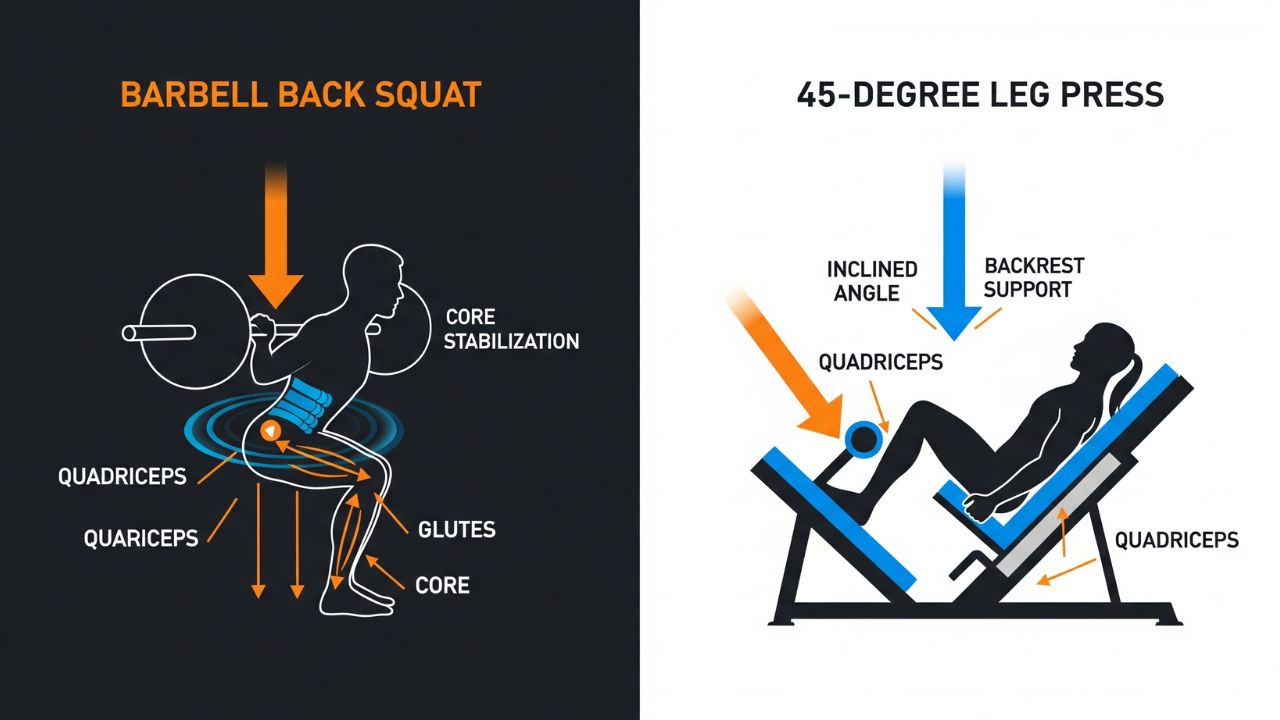
Walk into any commercial gym, and you will inevitably see a massive discrepancy between two lower-body exercises: the barbell back squat and the leg press. It is common to see an athlete who struggles to squat $225 \text{ lbs}$ loading up $600 \text{ lbs}$ or more on the leg press machine. This massive gap often leads to confusion about true lower-body strength.
Understanding the difference between leg press and squat strength requires looking beyond the sheer amount of weight on the bar or the machine. The discrepancy is rooted in physics, biomechanics, core stabilization, and the fundamental differences between closed-chain free-weight movements and fixed-axis machine exercises.
This guide breaks down exactly why your leg press is so much higher than your squat, the biomechanical differences in muscle activation, and how to effectively program both movements for maximum lower-body development.
The Physics of the Lift: Gravity and Angles
The primary reason leg press strength numbers are vastly inflated compared to squat numbers comes down to simple trigonometry and gravitational force.
During a barbell back squat, you are moving the weight vertically, directly fighting the force of gravity. If you have $300 \text{ lbs}$ on your back, your lower body and core must exert more than $300 \text{ lbs}$ of upward force to move the weight. Exactly $100\%$ of the barbell’s mass acts as downward resistance.
The leg press, however, operates on an inclined plane. Most commercial leg press machines are set at a $45^\circ$ angle. Because the weight is moving along an incline rather than straight up and down, the machine’s track absorbs a significant portion of the gravitational force.
To find the true resistance you are pushing on a $45^\circ$ leg press, you must calculate the sine of the angle. The mathematical formula for true force ($F_{True}$) on an inclined leg press is:$$F_{True} = (W_{Plates} + W_{Sled}) \times \sin(45^\circ)$$
Because $\sin(45^\circ)$ is approximately $0.7071$, you are only lifting about $70.7\%$ of the total weight loaded on the machine. If you load $500 \text{ lbs}$ onto a standard $118 \text{ lb}$ sled, you are not pushing $618 \text{ lbs}$ against gravity. You are pushing approximately $437 \text{ lbs}$. The angle alone immediately accounts for a massive drop in the actual force required by the muscles.
The Stabilization Deficit: Core and Spinal Loading
The second major difference between leg press and squat strength is the requirement for systemic stabilization.
The barbell back squat is an axially loaded movement. The weight rests on your upper back, meaning the load must be supported by your entire skeletal structure and core musculature before the force even reaches your legs.
To perform a squat, your spinal erectors, abdominals, obliques, and upper back must fire isometrically to keep your spine rigid and upright. If your core collapses, the lift fails, regardless of how strong your quadriceps or glutes are. For many lifters, the core is the limiting factor in the squat, not leg strength.
The leg press entirely removes this axial load and the need for core stabilization. During a leg press, your torso is braced against a padded backrest. The machine stabilizes your spine, allowing your central nervous system to direct $100\%$ of its neural drive into the prime movers (the quadriceps, glutes, and hamstrings).
Because you do not have to balance the weight or protect your spine from collapsing, you can push significantly closer to your true muscular failure point.
When converting leg press strength to squat strength, biomechanists often apply a “Stabilization Deficit Coefficient” ($C_{Stab}$), usually ranging from $0.70$ for novices to $0.85$ for advanced lifters, to account for the force lost when moving from a braced machine to an unbraced free weight.
Read Also: How to Choose a Realistic Goal for Your First 10K
Bodyweight Mechanics
Lifters often forget to calculate their own body mass when comparing these two exercises.
When you sit in a leg press machine, your body weight is supported by the seat. You are only moving the sled and the loaded plates.
When you perform a barbell back squat, you are lifting the barbell plus a massive percentage of your own body weight. While your feet and shanks remain on the floor, you are still moving your thighs, torso, arms, and head. Studies show that during a barbell squat, a lifter moves approximately $89\%$ of their total body weight.
If a $200 \text{ lb}$ athlete squats $315 \text{ lbs}$, they are actually moving a total systemic load of roughly $493 \text{ lbs}$.$$Total Load = W_{Barbell} + (BW \times 0.89)$$$$Total Load = 315 + (200 \times 0.89) = 493 \text{ lbs}$$
When you factor in the trigonometric angle of the machine, the lack of core stabilization, and the exclusion of body weight, it becomes mathematically obvious why a $600 \text{ lb}$ leg press does not equate to a $600 \text{ lb}$ squat.
Muscle Activation Differences
While both exercises primarily target the lower body, their biomechanical execution results in different muscle activation patterns.
Quadriceps Activation
Both the squat and the leg press are highly effective for building the quadriceps. However, the leg press allows you to isolate the quads more effectively by adjusting your foot placement. Placing your feet lower on the leg press platform increases knee flexion and reduces hip flexion, placing immense tension directly on the vastus lateralis, vastus medialis, and rectus femoris. The squat requires a more balanced distribution of force and cannot be manipulated to isolate the quads to the same extreme degree without compromising balance.
Glute and Hamstring Involvement
The barbell squat is far superior for posterior chain development. Because the squat requires you to actively extend your hips while balancing the load, the gluteus maximus and hamstrings are heavily recruited. Deeper squats significantly increase glute activation. On the leg press, because your hips are fixed into a seated position and the range of hip extension is limited, glute and hamstring activation is notably lower.
Core and Stabilizers
As established, the squat requires massive engagement from the transversus abdominis, rectus abdominis, and erector spinae. The leg press requires almost zero core activation. Furthermore, the free-weight squat forces the adductors (inner thighs) and abductors (outer hips) to work aggressively to track the knees properly over the toes. The fixed track of the leg press minimizes the need for these stabilizing muscles.
Range of Motion and the “Ego Lift” Factor
One of the most practical reasons leg press strength appears disproportionately high is standard gym behavior.
A strict barbell back squat requires the lifter to hit parallel, meaning the hip crease drops below the top of the knee. If a lifter cuts a squat high (a quarter squat), the movement is glaringly obvious to anyone watching.
On the leg press, range of motion is much harder to judge, and “ego lifting” is rampant. Many lifters load the machine with every plate available and perform micro-repetitions, bending their knees just a few inches before locking the weight back out.
Because the weight never reaches the bottom of the strength curve (deep knee and hip flexion), the lifter can move massive amounts of weight. If these lifters were forced to bring their knees to their chest on the leg press, their working weight would immediately drop by half.
Hypertrophy vs. Strength: Which Is Better?
Neither exercise is inherently “better” than the other; they serve different purposes in a well-structured training program.
For Pure Strength and Athleticism: The barbell back squat is the undisputed king. It builds systemic strength, reinforces the posterior chain, strengthens the core, and mimics athletic movements like jumping and sprinting. If you are an athlete, a powerlifter, or someone training for functional, real-world strength, the squat must be prioritized.
For Hypertrophy and Muscle Isolation: If your primary goal is bodybuilding and maximizing quadriceps hypertrophy, the leg press is an incredible tool. Because you do not have to worry about balancing a barbell or fatiguing your lower back, you can safely push the leg press to absolute muscular failure. It is much safer to perform drop sets, rest-pause sets, and high-rep exhaustion sets on a leg press than it is with a barbell on your back.
How to Program Both Movements
The most effective lower body training programs utilize both the squat and the leg press synergistically.
A standard approach is to place the barbell back squat at the beginning of your leg day. This is when your central nervous system is fresh, and your core stabilizers are fully rested. Perform your heavy, low-rep strength work (e.g., $3$ to $5$ sets of $4$ to $6$ reps) on the barbell squat to build raw strength and power.
Once your core and lower back are fatigued from squatting, move to the leg press. Because the machine provides stabilization, you can continue to hammer your quadriceps safely even though your systemic energy is depleted. Program the leg press for higher volume hypertrophy work (e.g., $3$ to $4$ sets of $10$ to $15$ reps), focusing on a deep range of motion and a slow, controlled eccentric (lowering) phase.
Summary
Leg press strength is not a direct translation to squat strength. When you leg press, you are pushing weight on a $45^\circ$ angle, removing the weight of your own body, and eliminating the need for your core to stabilize the load. A $500 \text{ lb}$ leg press might mathematically translate to a $225 \text{ lb}$ or $250 \text{ lb}$ squat depending on your body weight, biomechanics, and core strength.
Stop treating the two numbers as comparable metrics. Treat the squat as your primary builder of full-body athletic strength, and treat the leg press as a highly effective, safe machine for isolating the quadriceps and pushing the muscles to hypertrophy-inducing failure.