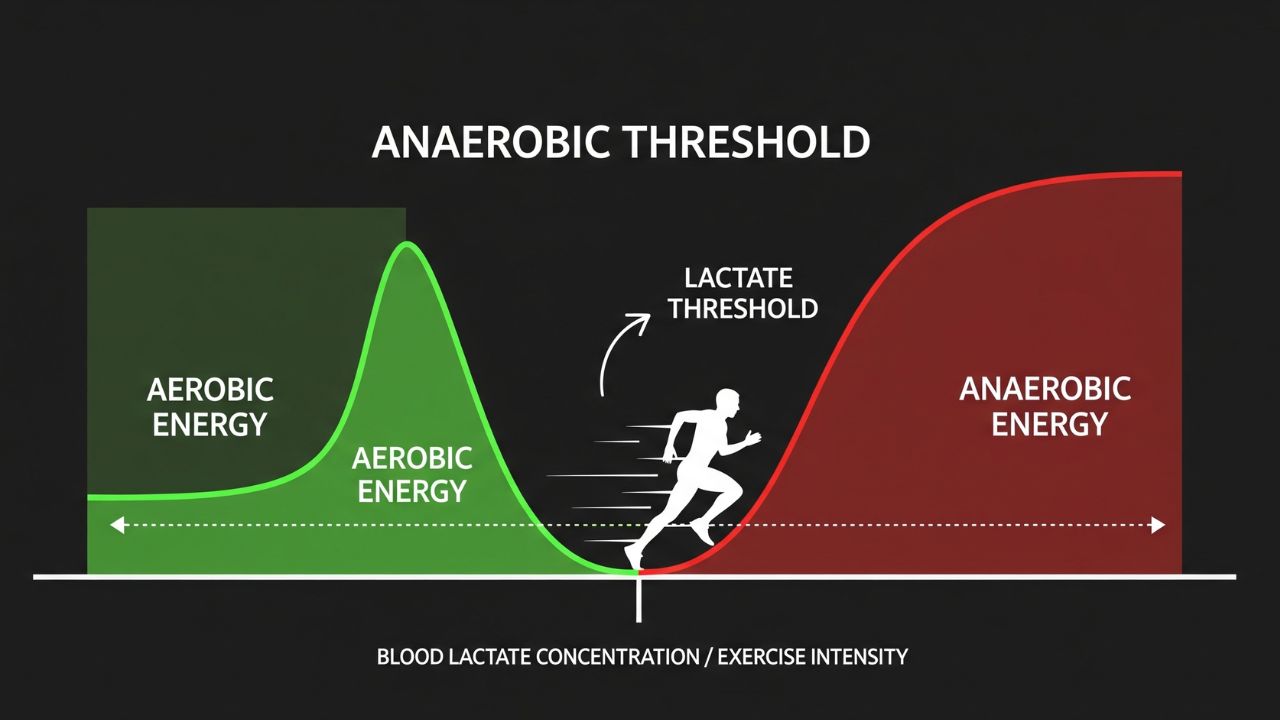
Anaerobic threshold (AT), frequently referred to in sports science as the lactate threshold or the onset of blood lactate accumulation (OBLA), is the exact physiological tipping point during exercise where your body transitions from primarily aerobic energy production to anaerobic energy production. At this specific intensity, blood lactate begins to accumulate in your bloodstream at a faster rate than your body can clear or recycle it.
Understanding, calculating, and training your anaerobic threshold is the single most critical factor in improving endurance performance. While VO2 max dictates the absolute ceiling of your aerobic capacity, your anaerobic threshold dictates what percentage of that capacity you can actually sustain for extended periods without succumbing to rapid muscular fatigue.
The Physiology of Energy Systems: Aerobic vs. Anaerobic
To understand why the anaerobic threshold matters, you must first understand how the human body generates Adenosine Triphosphate (ATP), the primary currency of cellular energy.
During low to moderate-intensity exercise, the body relies on the aerobic energy system. Oxygen is utilized to break down carbohydrates and fats into ATP. This process is highly efficient and produces almost no fatiguing byproducts, allowing you to sustain this pace for hours. The primary byproducts are water and carbon dioxide, which are easily exhaled.
As exercise intensity increases, the demand for ATP outpaces the aerobic system’s ability to deliver oxygen to the working muscles. To meet this immediate energy demand, the body engages the anaerobic glycolytic system. This system breaks down glucose without the presence of oxygen. While anaerobic glycolysis produces ATP rapidly, it also produces a byproduct called pyruvate.
When oxygen is scarce, pyruvate is converted into lactate. The accumulation of lactate is accompanied by an accumulation of hydrogen ions ($H^+$). It is the accumulation of these hydrogen ions—not the lactate itself—that lowers the pH of your blood and muscle tissue, causing the burning sensation, mechanical muscle fatigue, and eventual failure to maintain pace.
The anaerobic threshold is the exact equilibrium point. It is the maximum exercise intensity where the rate of lactate production is perfectly matched by the rate of lactate clearance. Push slightly past this point, and the rapid accumulation of hydrogen ions will force you to slow down.
Blood Lactate Concentration and the Two Thresholds
Sports scientists identify two distinct thresholds when testing an athlete’s blood lactate levels during an incremental step test.
- Aerobic Threshold (LT1): The point at which blood lactate first begins to rise above resting baseline levels, typically around $2.0 \text{ mmol/L}$. This represents the shift from purely fat oxidation to a mix of fat and carbohydrate oxidation.
- Anaerobic Threshold (LT2 / OBLA): The point of inflection where lactate accumulates exponentially, typically occurring at approximately $4.0 \text{ mmol/L}$ of blood lactate.
Data Table: Blood Lactate Concentration vs. Effort Level
| Effort Level | Perceived Exertion (RPE 1-10) | Blood Lactate (mmol/L) | Primary Fuel Source | Sustainable Duration |
|---|---|---|---|---|
| Easy Endurance | 2 – 3 | $1.0 – 1.5$ | Fats | 4+ Hours |
| Aerobic Threshold (LT1) | 4 – 5 | $1.5 – 2.0$ | Fats / Carbohydrates | 2 – 4 Hours |
| Tempo / Sweet Spot | 6 – 7 | $2.5 – 3.5$ | Carbohydrates | 60 – 90 Minutes |
| Anaerobic Threshold (LT2) | 8 – 8.5 | $4.0$ (varies) | Carbohydrates | 45 – 60 Minutes |
| VO2 Max | 9 – 10 | $6.0 – 10.0+$ | Carbohydrates (Anaerobic) | 3 – 8 Minutes |
How to Determine Your Anaerobic Threshold
Accurately determining your AT is essential for structuring training zones. There are several methods ranging from clinical laboratory testing to field estimations using heart rate data.
Laboratory Blood Lactate Testing
The gold standard for finding your anaerobic threshold is a graded exercise test in a clinical setting. The athlete runs on a treadmill or rides an ergometer, with the speed or wattage increasing every 3 to 4 minutes. At the end of each stage, a technician takes a small blood sample from the fingertip or earlobe to measure the exact millimoles of lactate per liter of blood ($\text{mmol/L}$). The AT is identified at the distinct exponential curve on the lactate graph.
Field Testing: The 30-Minute Time Trial
If lab testing is unavailable, the 30-minute time trial (commonly pioneered by Joe Friel) is the most accurate field test.
- Warm up thoroughly for 15 minutes.
- Begin a 30-minute time trial at the absolute maximum pace you can sustain evenly for the entire duration.
- Press the “lap” button on your heart rate monitor 10 minutes into the test.
- The average heart rate and average pace/power for the final 20 minutes of this test is your highly accurate estimated Anaerobic Threshold Heart Rate (LTHR) and Threshold Pace.
The Mathematics of Heart Rate Estimation
For athletes without power meters or the ability to perform a maximal time trial, mathematical formulas can estimate the AT based on Maximum Heart Rate ($HR_{max}$).
First, calculate your theoretical maximum heart rate using the Tanaka formula, which is generally more accurate than the traditional “220 – age” model:$$HR_{max} = 208 – (0.7 \times \text{Age})$$
Once $HR_{max}$ is established, the Anaerobic Threshold typically occurs at a specific percentage of that maximum. For untrained individuals, AT often occurs at $75\%$ to $80\%$ of $HR_{max}$. For highly trained endurance athletes, AT can be pushed to $85\%$ to $92\%$ of $HR_{max}$.
An intermediate athlete can estimate their AT Heart Rate ($HR_{AT}$) using an $85\%$ multiplier:$$HR_{AT} = HR_{max} \times 0.85$$
For a more precise physiological targeting, the Karvonen formula utilizes Heart Rate Reserve (HRR) by factoring in Resting Heart Rate ($HR_{rest}$). To find the target heart rate at the anaerobic threshold (assuming a $90\%$ intensity factor of HRR for a trained athlete):$$HR_{AT} = HR_{rest} + \left( 0.90 \times (HR_{max} – HR_{rest}) \right)$$
If an athlete has a maximum heart rate of 190 bpm and a resting heart rate of 50 bpm, their calculated threshold heart rate would be:$$HR_{AT} = 50 + \left( 0.90 \times (190 – 50) \right) = 50 + (0.90 \times 140) = 50 + 126 = 176 \text{ bpm}$$
Why Anaerobic Threshold is the Ultimate Predictor of Endurance Performance
While a high VO2 max is often celebrated, it merely indicates the size of an athlete’s aerobic engine. Anaerobic threshold determines how much of that engine can be utilized during a race.
Consider two marathon runners who both have a VO2 max of $60 \text{ ml/kg/min}$.
- Runner A has a poorly developed anaerobic threshold, occurring at $75\%$ of their VO2 max.
- Runner B has highly developed lactate clearance capabilities, pushing their anaerobic threshold to $88\%$ of their VO2 max.
In a race setting, Runner A will begin accumulating fatiguing hydrogen ions and forced to slow down when utilizing $75\%$ of their capacity. Runner B can run significantly faster, utilizing $88\%$ of their capacity for the entire race duration without crossing into anaerobic acidosis. Runner B will win the race every time, despite having the exact same VO2 max.
The primary goal of endurance training is to shift the lactate curve to the right, allowing the athlete to perform at higher power outputs or faster paces before hitting that $4.0 \text{ mmol/L}$ accumulation point.
Read Also: How to Choose a Realistic Goal for Your First 10K
Training Zones Based on Anaerobic Threshold
Using a percentage of your maximum heart rate to dictate training zones is often flawed because it does not account for your specific metabolic inflection points. Basing your training zones on your tested Anaerobic Threshold Heart Rate (LTHR) ensures your workouts are targeting the correct physiological adaptations.
Data Table: LTHR Training Zones
| Zone | Designation | % of LTHR | Perceived Exertion | Primary Physiological Adaptation |
|---|---|---|---|---|
| Zone 1 | Active Recovery | $< 85\%$ | Very Easy | Increased blood flow, clearance of metabolic waste. |
| Zone 2 | Aerobic Endurance | $85\% – 89\%$ | Easy / Conversational | Increased mitochondrial density, fat oxidation, capillary density. |
| Zone 3 | Tempo | $90\% – 94\%$ | Moderate | Increased muscular endurance, glycogen storage capacity. |
| Zone 4 | Sub-Threshold | $95\% – 99\%$ | Hard but Sustainable | Increased lactate clearance rate (Sweet Spot training). |
| Zone 5a | Super-Threshold | $100\% – 102\%$ | Very Hard | Direct elevation of the Anaerobic Threshold ceiling. |
| Zone 5b | Aerobic Capacity | $103\% – 106\%$ | Severe | Increases VO2 Max. |
| Zone 5c | Anaerobic Capacity | $> 106\%$ | Maximal | Increases maximal power output and anaerobic glycolysis. |
How to Improve Your Anaerobic Threshold
Improving your AT requires specific, targeted training protocols that stress the body’s ability to clear lactate. Randomly running or cycling hard is inefficient. You must spend precise amounts of time just below, exactly at, and slightly above your threshold pace.
1. Sweet Spot Training (SST)
Sweet spot training occurs at $88\%$ to $93\%$ of your threshold power or pace (upper Zone 3 into lower Zone 4). This intensity is highly effective because it creates massive physiological stress on your aerobic system and lactate clearance mechanisms without inducing the severe neuromuscular fatigue of true threshold work. Because the intensity is slightly sub-maximal, you can accumulate significantly more volume.
Sample Sweet Spot Workout:
- 15-minute easy warm-up.
- $3 \times 15$ minutes at Sweet Spot intensity.
- 5 minutes of easy spinning or jogging recovery between intervals.
- 10-minute cool-down.
2. Threshold Intervals (Cruise Intervals)
These intervals are performed exactly at your anaerobic threshold (Zone 4 / $100\%$ of LTHR). The goal is to flood the muscles with lactate and force the body to adapt to clearing it at high speeds. These intervals are mentally taxing and should be limited to 1-2 sessions per week.
Sample Threshold Workout:
- 15-minute easy warm-up.
- $5 \times 6$ minutes precisely at Anaerobic Threshold pace.
- 1 to 2 minutes of passive rest or very light active recovery between intervals.
- 10-minute cool-down.
3. Over-Under Intervals
Over-unders are advanced workouts designed to force the body to clear lactate while still operating at a high intensity. You alternate between a pace slightly above your AT (producing heavy lactate) and a pace slightly below your AT (forcing the body to clear the lactate while still working hard).
Sample Over-Under Workout:
- 15-minute easy warm-up.
- 3 sets of 9-minute blocks.
- During each 9-minute block, alternate: 2 minutes at $95\%$ of AT, followed by 1 minute at $105\%$ of AT. Repeat this 3-minute pattern three times per block.
- 5 minutes of easy recovery between blocks.
4. Polarized Training Dynamics
Counterintuitively, maximizing your anaerobic threshold requires spending the vast majority of your training time far below it. Elite endurance athletes utilize a polarized training model, spending roughly $80\%$ of their training volume in Zone 2 (below the Aerobic Threshold) and $20\%$ of their volume in high-intensity threshold or VO2 max zones.
Zone 2 training builds the foundational cellular infrastructure—specifically increasing the density of mitochondria (the cellular powerhouses that process lactate) and expanding the capillary network (which transports oxygen to the muscles and shuttles lactate away). Without a massive aerobic base built in Zone 2, your body will lack the biological hardware to process the lactate generated during threshold efforts.
Read Also: What Is the Difference Between Leg Press and Squat Strength?
Anaerobic Threshold Pace Mapping for Runners
For runners, knowing your threshold pace is the key to executing optimal race day pacing. Your threshold pace is roughly the pace you could sustain in a race for exactly 60 minutes. From this specific metric, you can mathematically extrapolate your optimal pacing for other race distances.
Data Table: Race Pace Projections Based on Threshold Pace
| Race Distance | % of Threshold Pace | Pace Adjustment (Example based on 7:00/mile AT Pace) |
|---|---|---|
| 5K (3.1 miles) | $103\% – 105\%$ | 6:40 to 6:45 / mile |
| 10K (6.2 miles) | $98\% – 100\%$ | 7:00 to 7:05 / mile |
| Half Marathon (13.1 miles) | $93\% – 95\%$ | 7:20 to 7:30 / mile |
| Marathon (26.2 miles) | $85\% – 88\%$ | 7:55 to 8:15 / mile |
Note: These pacing multipliers assume the athlete has adequate endurance and mileage volume to support the specific race distance. An athlete lacking long runs will heavily fade in a marathon regardless of their threshold pace.
Summary
The anaerobic threshold is the definitive metric for endurance performance. It marks the physiological limit where energy demand forces a shift from sustainable fat and carbohydrate oxidation to rapid, fatiguing anaerobic glycolysis.
By accurately testing your threshold using lactate sampling or field testing, applying the correct heart rate mathematics, and executing disciplined threshold and sweet-spot intervals, you train your body to clear metabolic waste efficiently. This physiological adaptation allows you to sustain faster speeds and higher power outputs for longer durations, directly translating to superior athletic performance.