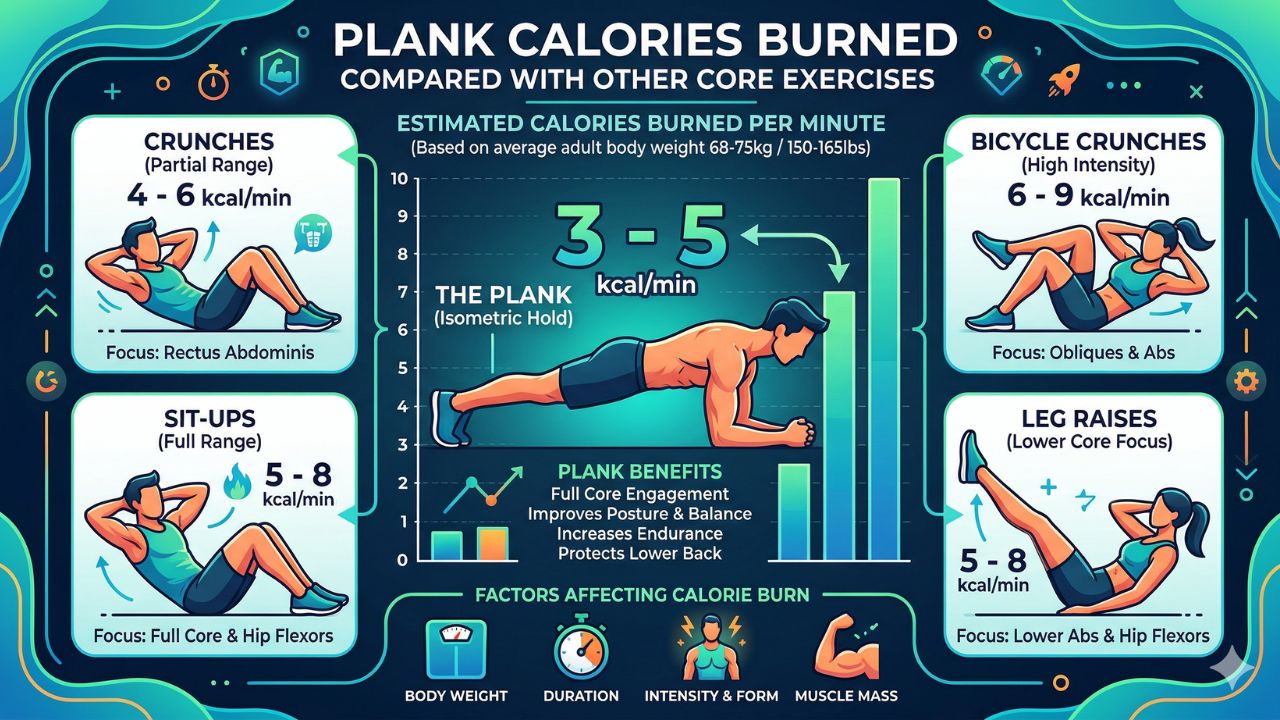
A standard forearm plank burns approximately 3.5 to 4.5 calories per minute for a 70 kg (154 lb) individual. Over a 10-minute session, that equals 35–45 kcal. This is lower than dynamic core exercises like crunches, bicycle crunches, or mountain climbers, which range from 5.0 to 8.0 METs and burn 50–90+ kcal in the same timeframe.
Planks are isometric. They generate sustained muscle tension without joint movement, which limits metabolic demand compared to concentric/eccentric movements that repeatedly contract and lengthen muscle fibers. The trade-off is high neuromuscular efficiency, spinal stability, and low joint stress. If your goal is pure calorie expenditure, planks are not optimal. If your goal is core resilience that supports heavier lifts, better posture, and injury prevention, planks remain a foundational tool.
Below is exact, MET-based data showing how planks compare to other core exercises, how weight and time scale calorie burn, and how to program them without overestimating energy expenditure.
How Many Calories Does a Plank Actually Burn?
Calorie burn for any exercise is calculated using the Metabolic Equivalent of Task (MET) system. One MET equals resting oxygen consumption (~3.5 mL O₂/kg/min). The formula for calorie expenditure is:
Calories Burned = MET × Weight(kg) × Duration(hours)
Standard planks register at 3.5–4.0 METs in exercise compendiums. We use 3.8 MET as the working baseline for a strict, unweighted forearm plank with proper form. The table below shows exact burn rates across common body weights and session lengths.
| Weight (kg) | Weight (lbs) | MET Value | kcal/min | kcal/5 min | kcal/10 min |
|---|---|---|---|---|---|
| 50 | 110 | 3.8 | 3.2 | 15.8 | 31.7 |
| 60 | 132 | 3.8 | 3.8 | 19.0 | 38.0 |
| 70 | 154 | 3.8 | 4.4 | 22.2 | 44.3 |
| 80 | 176 | 3.8 | 5.1 | 25.3 | 50.7 |
| 90 | 198 | 3.8 | 5.7 | 28.5 | 57.0 |
Key constraints:
- MET values assume continuous hold without rest. Any break resets the active metabolic clock.
- Isometric work produces minimal EPOC (excess post-exercise oxygen consumption). Calorie burn drops to near-resting levels within minutes of releasing the position.
- Wrist/elbow position, core bracing, and breathing rhythm affect efficiency but do not significantly change the MET classification.
- Fitness trackers frequently overestimate plank calories by 20–40% because they apply generic “strength training” METs (4.5–6.0) instead of isometric-specific values.
Plank vs Other Core Exercises: Calorie Comparison
Dynamic core exercises burn more calories because they involve repeated muscle shortening, longer range of motion, and often higher heart rate elevation. The table below compares planks to six common core movements using verified compendium MET ranges. All values are calculated for a 70 kg individual.
| Exercise | Primary Mechanism | MET Range | kcal/min (70 kg) | kcal/10 min |
|---|---|---|---|---|
| Forearm Plank | Isometric | 3.5–4.0 | 4.1–4.7 | 40.8–46.7 |
| Dead Bug | Isometric/Dynamic | 3.5 | 4.1 | 40.8 |
| Standard Crunches | Concentric | 4.5–5.0 | 5.2–5.8 | 52.5–58.3 |
| Bicycle Crunches | Dynamic | 5.0–5.5 | 5.8–6.4 | 58.3–64.2 |
| Russian Twists | Rotational | 4.5–5.0 | 5.2–5.8 | 52.5–58.3 |
| Ab Wheel Rollout | Eccentric/Concentric | 6.0–6.5 | 7.0–7.6 | 70.0–75.8 |
| Mountain Climbers | Cardio/Core | 7.5–8.5 | 8.7–9.9 | 87.5–99.2 |
Why the gap exists:
- Muscle recruitment pattern: Planks maintain static tension across the rectus abdominis, transverse abdominis, obliques, and spinal erectors. Dynamic moves repeatedly fire and relax fibers, increasing ATP turnover and oxygen demand.
- Cardiovascular load: Mountain climbers and ab wheel rollouts elevate heart rate into moderate-to-vigorous zones, pushing METs higher. Planks rarely exceed light-intensity HR zones unless weighted or paired with movement.
- Work-to-rest ratio: A 10-minute plank session is typically continuous. A 10-minute crunch or mountain climber session includes natural micro-rests between reps, but the metabolic cost per active minute remains higher due to movement velocity and joint displacement.
Read Also: Do Kettlebell Workouts Burn More Calories Than Regular Weights?
The Math Behind Core Calorie Burn
To scale plank calorie burn for your own weight or session length, use the exact formula:
Calories = MET × Weight(kg) × Duration(hours)
Or simplified for minutes: Calories = (MET × Weight(kg) × Duration(minutes)) / 60
Weight scaling example (10-minute plank):
- 55 kg: (3.8 × 55 × 10) / 60 = 34.8 kcal
- 75 kg: (3.8 × 75 × 10) / 60 = 47.5 kcal
- 95 kg: (3.8 × 95 × 10) / 60 = 60.2 kcal
Time scaling example (70 kg, 3.8 MET):
- 1 minute: 4.4 kcal
- 5 minutes: 22.2 kcal
- 10 minutes: 44.3 kcal
- 15 minutes: 66.5 kcal (form degradation likely beyond 10–12 min for most)
Accuracy constraints:
- MET databases represent population averages. Individual burn varies ±15% based on muscle mass, fiber type distribution, and movement economy.
- Temperature, hydration, and recent meals do not change the MET classification but can slightly alter perceived exertion and sweat rate.
- 1 kcal = 4.184 kJ. For international tracking, multiply kcal values by 4.184.
Do not assume linear scaling indefinitely. After ~8–10 minutes, core fatigue typically forces form breakdown (hip sag, shoulder protraction, breath holding), which reduces active muscle engagement and may lower effective MET to 3.0–3.2. Logging broken sets as continuous work inflates calorie totals.
Why Planks Still Outperform for Core Strength (Despite Lower Calorie Burn)
Calorie burn measures energy expenditure, not structural adaptation. Planks excel in areas dynamic moves do not:
- Transverse Abdominis Activation: The deep core stabilizer fires continuously during isometric holds, improving intra-abdominal pressure management. This translates to safer heavy squats, deadlifts, and overhead presses.
- Spinal Load Management: Crunches generate repeated flexion torque on lumbar discs. Planks distribute load evenly across the anterior and posterior chain with neutral spine alignment, reducing disc compression risk.
- Neuromuscular Efficiency: Static holds improve motor unit synchronization. You learn to brace without breath-holding, a skill that carries over to athletic movements and daily lifting.
- Indirect Calorie Impact: A stronger core improves movement economy in cardio and strength training. Better posture and stability reduce energy leaks, allowing higher training volumes over time, which indirectly increases weekly calorie expenditure.
Planks are not fat-loss tools. They are structural integrity tools. Program them for stability, not energy deficit.
Read Also: What Is a Normal Leg to Body Ratio?
How to Maximize Calorie Burn With Plank Variations
If you want to increase plank calorie expenditure without abandoning the movement pattern, introduce controlled dynamic or loaded variations. These shift the exercise from pure isometric to hybrid isometric-dynamic, raising MET values by 1.5–2.5 points.
| Variation | Mechanism Shift | Approx. MET | kcal/min (70 kg) |
|---|---|---|---|
| Weighted Plank (+10 kg) | Increased resistance | 4.8–5.2 | 5.6–6.1 |
| Plank Jacks | Cardio + core coordination | 6.0–6.5 | 7.0–7.6 |
| Plank Shoulder Taps | Anti-rotation stability | 5.0–5.5 | 5.8–6.4 |
| Walking Plank (Up/Down) | Dynamic elbow/knee transition | 5.5–6.0 | 6.4–7.0 |
| Stir-the-Pot (Stability Ball) | Isometric + micro-movement | 5.0–5.5 | 5.8–6.4 |
Programming rules:
- Increase intensity before duration. A 45-second weighted plank burns more than a 3-minute unweighted plank with compromised form.
- Limit dynamic plank variations to 3–4 sets of 30–45 seconds. Form breakdown increases injury risk to shoulders and lumbar spine.
- Track actual work time. Excluding rest periods prevents calorie overestimation.
- Do not use plank variations as primary cardio substitutes. They lack sustained cardiovascular demand for significant fat oxidation.
Real-World Planning: Integrating Planks Into a Fat-Loss or Core Program
Planks should be positioned within a broader training architecture based on your primary goal.
For fat loss:
- Calorie deficit drives weight loss, not core exercise selection.
- Use planks 2–3x/week for 3 sets of 30–60 seconds to maintain core stability during cardio and resistance training.
- Pair with dynamic core work (mountain climbers, cable rotations) 1–2x/week for higher metabolic demand.
- Log plank calories accurately using the 3.5–4.0 MET range. Do not apply “HIIT” or “strength training” multipliers.
For strength/athletic performance:
- Program planks after heavy compound lifts or as standalone stability work.
- Progress via load (weighted vest), time (10-second increments), or instability (sliders, medicine ball) rather than volume.
- Use heart rate or perceived exertion to monitor fatigue, not calorie targets.
Tracking best practices:
- Measure weight in kg for formula accuracy.
- Round session time to nearest 30 seconds.
- Subtract rest intervals from total time.
- Re-calculate monthly if body weight changes by >2 kg.
- Expect ±10% variance between calculated and actual burn due to individual metabolic differences.
Frequently Asked Questions
Do planks burn more calories than crunches?
No. Standard crunches operate at 4.5–5.0 MET, burning ~15–25% more calories per minute than planks for the same body weight. Planks prioritize spinal neutrality and deep core activation over metabolic output.
How accurate are fitness trackers for plank calorie burn?
Most overestimate by 20–40%. Trackers often default to “general strength training” (4.5–6.0 MET) or apply heart-rate algorithms calibrated for dynamic movement. Use the 3.5–4.0 MET range and manual calculation for accuracy.
Does holding a plank longer linearly increase calories?
Yes, but only while form and muscle engagement remain intact. Beyond 10–12 minutes, fatigue typically causes hip drop, shoulder shrug, or breath holding, which reduces active fiber recruitment and lowers effective MET. Quality > duration.
Should I choose core exercises based on calorie burn for fat loss?
No. Fat loss requires a sustained caloric deficit, adequate protein, and consistent training. Core exercises contribute minimally to total daily energy expenditure. Select moves based on spinal health, movement goals, and injury history. Use planks for stability, dynamic moves for metabolic demand, and diet/cardio for deficit creation.
Can weighted planks replace cardio for calorie burn?
No. Even weighted planks max out at ~5.5 MET, which remains in the light-to-moderate intensity zone. Cardio exercises like running, cycling, or rowing operate at 6.0–12.0+ MET, providing superior cardiovascular adaptation and calorie expenditure per unit time.
Final Summary
A standard plank burns 3.5–4.5 kcal/min for a 70 kg individual, totaling 35–45 kcal per 10-minute session. This is lower than dynamic core exercises due to its isometric nature, limited range of motion, and minimal cardiovascular load. The exact burn scales linearly with weight and time using the formula: Calories = MET × Weight(kg) × Duration(hours).
Planks are not high-calorie burners. They are high-stability builders. Use them to reinforce neutral spine positioning, improve intra-abdominal pressure, and support heavier lifts. Pair them with dynamic core movements and structured cardio when calorie expenditure is the priority. Track work time accurately, exclude rest, and apply the correct MET range to avoid overestimation.
For programming, prioritize form over duration, progress via load or instability, and align exercise selection with your primary training goal. Calorie data is useful for tracking, but structural adaptation drives long-term performance and injury resilience.