The fitness industry frequently debates the metabolic efficiency of different resistance training modalities. When programming workouts for fat loss, athletes and coaches often ask a highly specific question: Do kettlebell workouts burn more calories than traditional weightlifting with dumbbells and barbells?
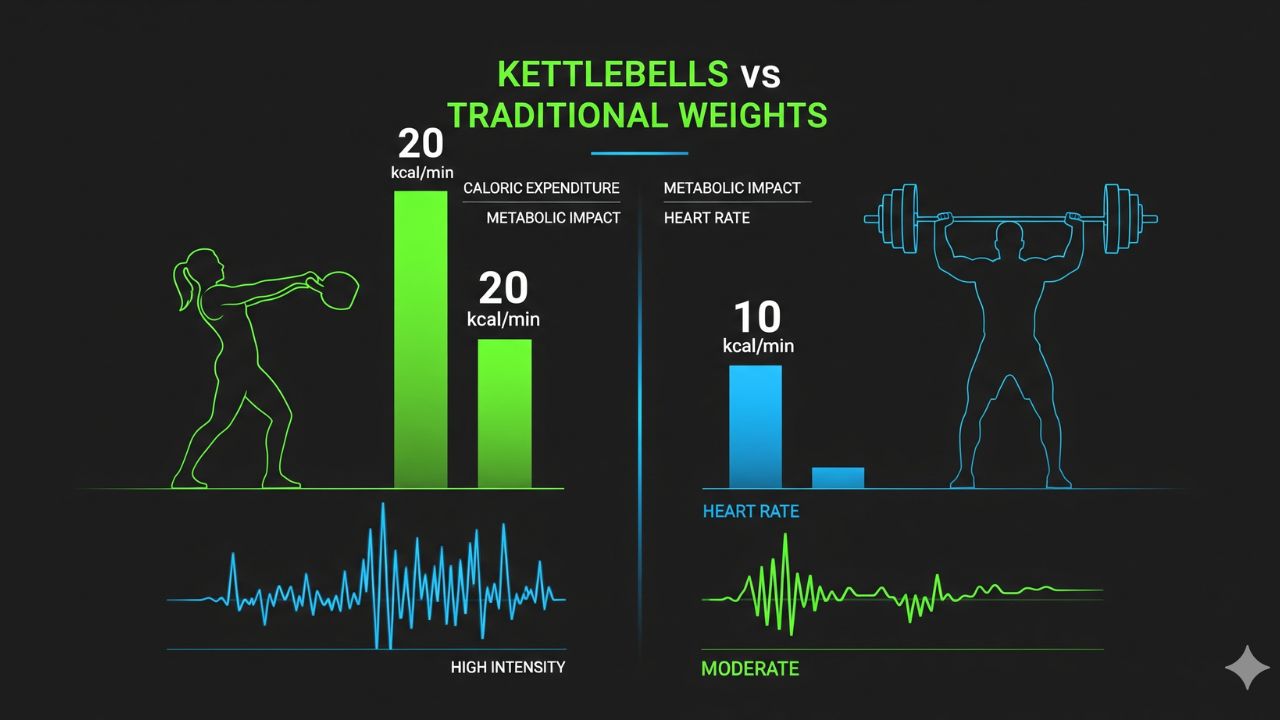
The short answer is yes. Minute-per-minute, ballistic kettlebell training burns significantly more calories than traditional resistance training. In fact, clinical data shows that high-intensity kettlebell intervals can rival all-out sprinting in terms of acute caloric expenditure.
However, understanding why this happens requires a deep dive into biomechanics, metabolic pathways, and the difference between ballistic movements and traditional grind lifts. This guide breaks down the exact caloric expenditure data, the science of energy systems, and when you should use each tool for optimal body composition.
The Biomechanics: Center of Mass and Ballistic Movement
The primary reason kettlebells elicit a higher immediate caloric burn lies in their physical design. A dumbbell or barbell has a balanced center of mass; the weight is evenly distributed perfectly in line with the handle. When you lift a dumbbell, the resistance moves in a predictable, linear path.
A kettlebell’s center of mass is displaced. The bulk of the weight sits six to eight inches away from the handle. This displaced center of gravity creates a rotational force (torque) that constantly tries to pull the bell out of your grip. To control this offset weight, your body must recruit hundreds of smaller stabilizer muscles in the core, forearms, and posterior chain that remain dormant during traditional dumbbell exercises.
Furthermore, traditional weightlifting relies on “grind” movements (e.g., bench press, strict overhead press, bicep curls) where the lifter moves the weight slowly and with strict isolation. Kettlebell training relies on “ballistic” movements (e.g., swings, snatches, cleans).
Ballistic movements require explosive acceleration and rapid deceleration. You are not just lifting the weight; you are throwing it and catching it. This rapid force production demands massive amounts of energy.
The Clinical Data: Calories Burned Per Minute
To accurately compare caloric expenditure, sports scientists measure oxygen consumption (VO2) and blood lactate levels during exercise.
The American Council on Exercise (ACE) conducted a landmark clinical study to determine the true metabolic cost of kettlebell training. Researchers had participants perform a kettlebell snatch protocol (15 seconds of work followed by 15 seconds of rest) for 20 minutes.
The results were unprecedented for resistance training. Participants burned an average of 13.6 calories per minute aerobically, plus an additional 6.6 calories per minute anaerobically (measured via blood lactate accumulation).
This resulted in a total caloric expenditure of 20.2 calories per minute. For a 20-minute workout, participants burned over 400 calories. The lead researchers noted that this level of caloric burn is equivalent to running at a 6-minute mile pace or cross-country skiing uphill at a fast pace.
Traditional weightlifting simply does not match this acute per-minute burn rate because traditional lifting requires longer rest periods between sets to allow the central nervous system to recover.
Data Table: Caloric Expenditure by Modality (Per 60 Minutes)
The following table provides estimated caloric expenditure for a 180-pound (81.6 kg) individual performing 60 minutes of various exercises, including rest periods typical for each modality.
| Exercise Modality | Intensity Level | Primary Energy System | Est. Calories Burned (per hour) |
|---|---|---|---|
| Kettlebell Snatch/Swing Intervals | High (VO2 Max) | Anaerobic/Aerobic Hybrid | 800 – 1,200 |
| Heavy Barbell Powerlifting | High (CNS) | ATP-PC (Phosphagen) | 250 – 350 |
| Traditional Bodybuilding (Hypertrophy) | Moderate | Anaerobic Glycolysis | 350 – 450 |
| High-Intensity Interval Training (Bodyweight) | High | Anaerobic Glycolysis | 600 – 800 |
| Steady State Running (6 mph) | Moderate | Aerobic (Oxidative) | 800 – 900 |
As the data shows, traditional heavy barbell lifting burns surprisingly few calories during the actual workout. The sets last only 10 to 20 seconds, followed by 3 to 5 minutes of complete rest. Kettlebell training, when structured as a continuous flow or interval circuit, keeps the heart rate elevated near 85 to 90 percent of its maximum, resulting in a burn rate that mirrors intense cardiovascular exercise.
Why Kettlebells Trigger a Higher Caloric Burn
The massive 20-calorie-per-minute burn rate of kettlebell training is driven by three specific physiological factors.
1. Full-Body Muscle Recruitment
Traditional weightlifting often isolates muscle groups. A leg extension machine only works the quadriceps. A dumbbell curl only works the biceps. Because less total muscle mass is working, the cardiovascular system does not have to work as hard to deliver oxygenated blood.
The kettlebell swing and snatch are full-body movements. A heavy swing requires maximum contraction of the glutes, hamstrings, quadriceps, erector spinae, latissimus dorsi, abdominals, and forearms simultaneously. Because almost every major muscle group in the body is firing at once, the heart and lungs must work at maximum capacity, driving up the metabolic cost of the exercise.
2. The Eccentric Deceleration Phase
During a barbell deadlift, you pull the weight from the floor, and you can simply drop it or lower it slowly. During a kettlebell swing, gravity pulls the bell back down between your legs with accelerating force.
Your posterior chain must act as a shock absorber to violently decelerate the bell before rapidly reversing its direction. This high-speed eccentric loading creates massive microscopic muscle damage and metabolic stress, which requires immense energy to execute.
3. Cardiovascular Cross-Training
Kettlebell complexes (linking multiple movements together without putting the bell down, such as clean, to press, to squat) bridge the gap between strength training and cardiovascular conditioning. Traditional weights give your heart rate time to return to baseline. Kettlebell flows keep your heart rate pinned in Zone 4 or Zone 5 for extended durations, forcing the body to rely heavily on the aerobic energy system while simultaneously challenging muscular endurance.
EPOC: The Afterburn Effect
When discussing caloric burn, we must account for Excess Post-Exercise Oxygen Consumption (EPOC), commonly known as the “afterburn effect.”
When you perform intense exercise, you create an oxygen debt. After the workout finishes, your body must consume excess oxygen to restore ATP stores, clear lactic acid, repair muscle tissue, and return the body’s core temperature to normal. This recovery process requires calories.
Because ballistic kettlebell training creates massive systemic fatigue and high blood lactate levels, it triggers a significant EPOC response. Studies suggest that high-intensity kettlebell protocols can elevate your resting metabolic rate for up to 36 hours post-workout. This means you are burning additional calories while sitting at your desk or sleeping the next day.
Traditional bodybuilding also triggers EPOC due to muscle tissue damage, but generally not to the same cardiovascular extreme as continuous ballistic intervals.
When Traditional Weights Are Better for Fat Loss
If kettlebells burn more calories per minute, does that make them universally superior for fat loss? No. Traditional barbells and dumbbells hold a distinct, long-term metabolic advantage.
Kettlebells are limited by absolute load. It is incredibly difficult to progressively overload a kettlebell swing beyond 100 pounds. Barbells allow for infinite micro-loading. You can squat 300, 400, or 500 pounds using a barbell.
This heavy, progressive overload is the primary driver of muscular hypertrophy (muscle growth). Muscle tissue is highly metabolically active. One pound of resting muscle tissue burns roughly three times as many calories per day as one pound of adipose (fat) tissue.
By using traditional barbells to build 10 pounds of new muscle mass, you permanently increase your Basal Metabolic Rate (BMR). You will burn more calories 24 hours a day, 7 days a week, regardless of whether you exercise that day or not. While a kettlebell workout wins the short-term battle of calories burned during the session, heavy barbell lifting wins the long-term war by fundamentally changing your body’s daily energy requirements.
Data Table: Kettlebells vs. Traditional Weights by Goal
| Fitness Goal | Superior Modality | Reason |
|---|---|---|
| Maximum Acute Calorie Burn | Kettlebells | Keeps heart rate elevated, recruits full body simultaneously. |
| Maximum Muscle Hypertrophy | Traditional Weights | Allows for heavy progressive overload and isolation. |
| Cardiovascular Endurance | Kettlebells | Sustained high-rep ballistics mimic sprinting. |
| Absolute Peak Strength (1RM) | Traditional Weights | Central nervous system adaptation requires heavy barbells. |
| Post-Workout EPOC (Afterburn) | Tie | Both trigger high EPOC through different mechanisms (metabolic vs structural stress). |
How to Program for Maximum Metabolic Effect
The most scientifically sound approach to body composition does not force you to choose between kettlebells and traditional weights. The optimal program utilizes both tools for their specific metabolic advantages.
A highly effective split involves using heavy barbells at the beginning of your workout to stimulate the central nervous system and drive muscle hypertrophy. For example, performing 4 sets of 5 repetitions on the heavy barbell back squat. This builds the muscle that increases your daily resting metabolic rate.
Once the heavy strength work is completed, transition to kettlebells for metabolic conditioning. Instead of jogging on a treadmill for 30 minutes, perform a 10-minute kettlebell swing interval protocol (e.g., 30 seconds of maximum effort swings, 30 seconds of rest). This spikes the heart rate, maximizes acute caloric expenditure, and triggers massive EPOC, all in a fraction of the time required by traditional cardio.
Summary
The data is clear: minute-for-minute, kettlebell workouts burn significantly more calories than traditional weightlifting routines. The combination of full-body ballistic movement, cardiovascular demand, and continuous tension allows kettlebell training to push the body to burn upwards of 20 calories per minute.
However, viewing fat loss purely through the lens of per-minute caloric burn is a mistake. Traditional weightlifting with dumbbells and barbells is essential for building dense muscle mass, which permanently elevates your resting metabolism. For optimal body composition, athletes should use traditional weights to build the engine, and kettlebells to burn the fuel.