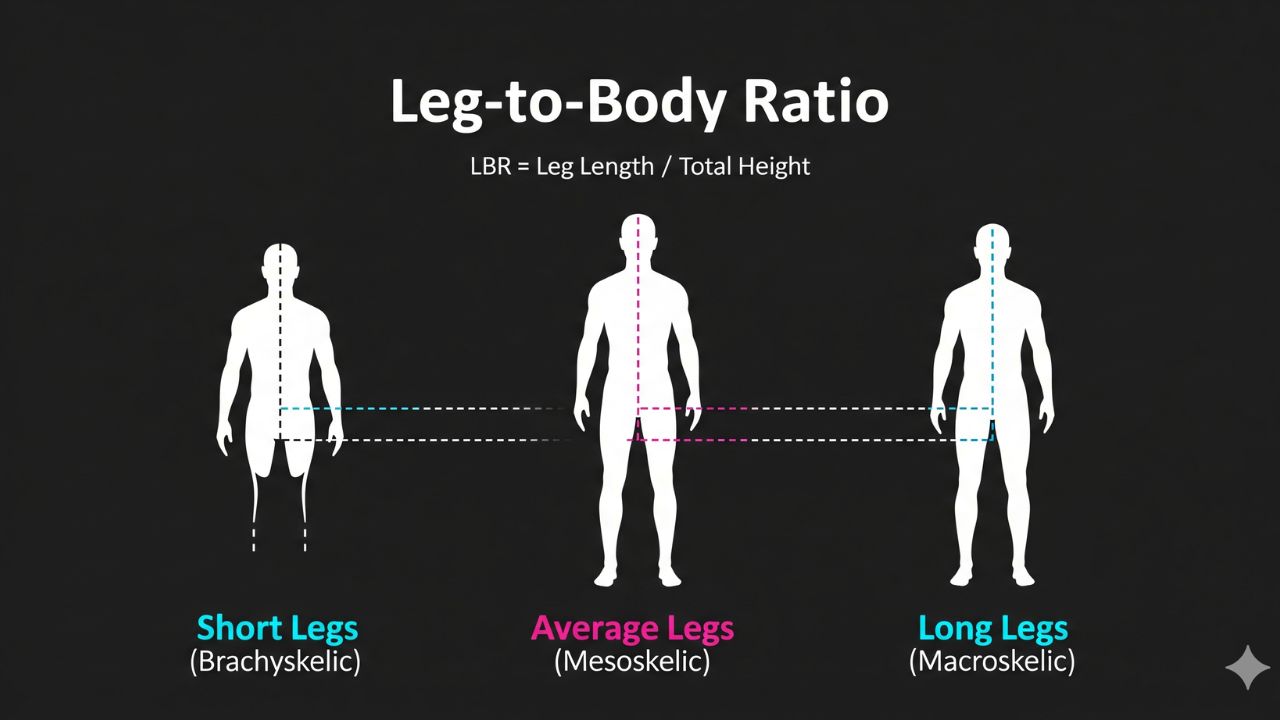
The human body comes in a vast array of shapes and sizes, but anthropologists, biomechanists, and sports scientists have long studied the specific proportions that make up the human frame. One of the most frequently analyzed metrics is the Leg-to-Body Ratio (LBR).
Whether you are an athlete looking to understand your biomechanical leverages, a tailoring enthusiast seeking the perfect fit, or simply curious about evolutionary biology, understanding your leg-to-body ratio provides profound insights into how your body operates in physical space.
This guide breaks down exactly what a normal leg-to-body ratio is, the mathematical formulas used to calculate it, how it varies across populations, and its definitive impact on athletic performance, aesthetics, and evolutionary survival.
Understanding the Leg-to-Body Ratio (LBR)
The Leg-to-Body Ratio is a precise anthropometric measurement that compares the length of an individual’s legs to their total standing height. It dictates where an individual’s center of gravity lies and determines the mechanical lever lengths of their lower body.
In clinical and scientific settings, leg length is not measured the same way a tailor measures an inseam for trousers. An inseam only measures the inner leg from the crotch to the floor. Anatomical leg length must account for the entire femur and pelvic connection.
The Mathematics of Measurement
To calculate a true Leg-to-Body Ratio, scientists measure from the Greater Trochanter (the bony prominence at the top of the femur, palpable on the side of the hip) down to the lateral malleolus (the outer ankle bone), or directly to the floor if standing barefoot.
The mathematical formula for the Leg-to-Body Ratio is expressed as:$$\text{LBR} = \frac{L_{Leg}}{H_{Total}}$$
Where:
- $L_{Leg}$ represents the anatomical leg length.
- $H_{Total}$ represents the total standing height of the individual.
For example, if an individual has an anatomical leg length of $34 \text{ inches}$ and a total standing height of $70 \text{ inches}$, their calculation would be:$$\text{LBR} = \frac{34}{70} \approx 0.485$$
This indicates that their legs account for $48.5\%$ of their total body height.
Another commonly used metric in anthropometry is the Cormic Index, also known as the Sitting Height Ratio (SHR). This is the inverse approach to measuring proportions, focusing on torso length relative to total height. It is calculated by dividing sitting height by standing height. A high Cormic Index indicates a long torso and short legs, while a low Cormic Index indicates a short torso and long legs.$$\text{SHR} = \frac{H_{Sitting}}{H_{Total}}$$
What is Considered a “Normal” Leg-to-Body Ratio?
The definition of “normal” varies depending on biological sex, genetics, and ancestral geographic origins. However, massive global anthropometric data sets have established clear baseline averages.
For the general adult human population, a normal Leg-to-Body Ratio typically falls between $0.45$ and $0.50$. This means that for the average human, the legs make up slightly less than half of their total standing height.
Gender Differences in Proportions
A common anatomical misconception is that women have longer legs than men. In absolute terms, men generally have longer legs simply because men are, on average, taller than women. However, when measured proportionally (using the LBR formula), women generally display a slightly higher Leg-to-Body Ratio than men.
- Average Adult Male LBR: $0.450 \text{ to } 0.470$
- Average Adult Female LBR: $0.465 \text{ to } 0.490$
Women typically possess slightly longer legs relative to their total height, paired with a shorter torso. Men generally possess a proportionately longer torso and slightly shorter legs relative to their overall stature. This dimorphism is linked to evolutionary differences in pelvic structure and center of gravity management.
Anthropometric Data Table: Leg-to-Body Ratio Classifications
| Classification | LBR Range | Somatotype Tendency | Center of Gravity |
|---|---|---|---|
| Short Legs (Brachyskelic) | $< 0.45$ | Endomorph / Mesomorph | Low (High Stability) |
| Average Legs (Mesoskelic) | $0.45 – 0.48$ | Normative | Neutral |
| Long Legs (Macroskelic) | $> 0.48$ | Ectomorph | High (Lower Stability) |
Geographic and Ancestral Variations
Human populations evolved specific body proportions as thermoregulatory adaptations to their environments, a concept governed by Allen’s Rule and Bergmann’s Rule in evolutionary biology.
- Cold Climates: Populations with ancestral roots in extremely cold environments (such as the Inuit) evolved lower Leg-to-Body Ratios. Shorter limbs and longer, thicker torsos minimize the body’s surface-area-to-mass ratio, effectively conserving core body heat in freezing temperatures.
- Hot Climates: Populations with ancestral roots in hot, arid environments (such as East African Nilotic peoples) evolved highly elevated Leg-to-Body Ratios. Exceptionally long, slender limbs maximize the body’s surface area, allowing for rapid heat dissipation and efficient cooling in blistering climates.
Read Also: Why Ape Index Matters in Climbing and Sports?
The Evolutionary Biology of Long Legs
From an evolutionary standpoint, the human Leg-to-Body Ratio is a defining characteristic of our species. When our early hominid ancestors transitioned from arboreal (tree-dwelling) environments to bipedal locomotion on the African savanna, a significant morphological shift occurred.
The genus Homo evolved significantly longer legs relative to body size compared to earlier species like Australopithecus. This elongation of the lower limbs was entirely driven by the biomechanical demands of persistence hunting.
Persistence hunting required early humans to track and run down prey over vast distances in the heat of the day. A higher Leg-to-Body Ratio mathematically increases stride length. A longer stride length allows an organism to cover more ground per kinetic cycle, drastically reducing the metabolic cost of running. Humans became the ultimate endurance runners of the animal kingdom precisely because our Leg-to-Body Ratio evolved to prioritize locomotive efficiency over explosive strength or climbing ability.
Leg-to-Body Ratio and Athletic Performance
In modern sports science, anthropometry is used to identify athletes who possess the optimal biomechanical leverages for specific disciplines. Your Leg-to-Body Ratio directly influences the physics of how you generate force, overcome resistance, and move through physical mediums.
Running and Track Athletics
Distance runners and sprinters almost universally benefit from a high Leg-to-Body Ratio (Macroskelic). In the physics of running, the leg acts as a swinging pendulum. A longer pendulum covers a greater arc distance per swing. Therefore, a runner with an LBR of $0.50$ will inherently cover more ground per stride than a runner of the exact same height with an LBR of $0.46$. This mechanical efficiency is why elite marathoners typically possess disproportionately long legs relative to their compact torsos.
Swimming
Swimming requires a vastly different set of hydrodynamic proportions. Elite swimmers, most notably Michael Phelps, exhibit extremely low Leg-to-Body Ratios (Brachyskelic). A long torso and relatively short legs provide a massive advantage in the water. The torso acts as the hull of a ship; a longer hull reduces wave drag and improves buoyancy. Furthermore, a longer torso combined with a massive arm span allows for a longer, more powerful pulling stroke, while shorter legs reduce the metabolic cost of kicking and minimize dragging resistance.
Powerlifting and Weightlifting
Powerlifting is governed by the physics of mechanical work. Work ($W$) is equal to Force ($F$) multiplied by Distance ($d$):$$W = F \times d$$
In the squat and the deadlift, the goal is to move massive amounts of weight over the shortest possible distance. A lifter with a low Leg-to-Body Ratio has a profound biomechanical advantage. Shorter legs mean a shorter femur and a shorter tibia. This reduces the total distance the lifter must travel to reach parallel in a squat.
Furthermore, shorter femurs drastically reduce the lever arm extending from the hip joint to the knee, minimizing the torque placed on the lower back and allowing the lifter to maintain a more upright, mechanically advantageous torso angle. Conversely, lifters with a high Leg-to-Body Ratio (long legs) must hinge forward aggressively during a squat to maintain their center of gravity, placing immense strain on the lumbar erectors.
Gymnastics and Combat Sports
Gymnastics strictly requires a low center of gravity for rotational balance and spatial awareness. Gymnasts generally possess low Leg-to-Body Ratios. Shorter limbs reduce the radius of rotation, allowing gymnasts to spin, flip, and twist at much higher velocities (due to the conservation of angular momentum).
In combat sports like wrestling and judo, a lower LBR is highly advantageous. A shorter leg length lowers the body’s center of mass, making the athlete vastly more difficult to uproot, throw, or take down.
Read Also: What Is Anaerobic Threshold and Why Does It Matter?
Aesthetics and The Psychology of Attractiveness
Beyond athletic performance and biomechanics, the Leg-to-Body Ratio has been heavily studied in the fields of evolutionary psychology and aesthetics. Research consistently demonstrates that humans possess an innate visual preference for specific physical proportions.
Multiple cross-cultural studies have shown that both men and women perceive individuals with slightly higher-than-average Leg-to-Body Ratios as more physically attractive. When presented with manipulated silhouettes of human figures, subjects consistently rate figures with legs that are roughly $5\%$ longer than the baseline average as the most aesthetically pleasing.
Evolutionary psychologists hypothesize that this preference is rooted in biological fitness indicators. Throughout human history, proportionately long legs were indicators of excellent biomechanical efficiency, strong nutritional uptake during childhood development, and superior cardiovascular health. Conversely, extreme deviations from the norm (excessively short legs or excessively long legs) are often visually flagged by the human brain as potential indicators of genetic anomalies, poor developmental environments, or underlying health conditions.
The Fashion Industry and Proportion Illusion
The fashion industry has capitalized on the psychological preference for longer legs for centuries. The primary goal of many sartorial techniques is to artificially inflate the perceived Leg-to-Body Ratio.
- High-Waisted Trousers: Wearing pants that sit at the natural waist (above the navel) rather than the hips artificially extends the visual line of the leg upward, making the torso appear shorter and the legs appear significantly longer.
- Heels and Platform Shoes: High heels physically elevate the ankle and elongate the line of the calf, directly increasing the measurable distance from the floor to the hip.
- Crop Tops and Tucked Shirts: Shortening the visual length of the shirt disrupts the true baseline of the torso, tricking the eye into assuming the legs begin higher on the body than they anatomically do.
Health Implications of Leg Length
While primarily viewed through the lens of aesthetics or athletics, clinical research has established correlations between leg length proportions and certain long-term health outcomes. Leg length is heavily influenced by environmental factors during prepubescent development, specifically nutrition and stress.
During childhood growth spurts, the long bones of the legs (the femur and tibia) are highly sensitive to nutritional deficits. If a child does not receive adequate calories, protein, and calcium, the growth plates in the legs will cease lengthening prematurely to conserve energy for vital organ function in the torso. Therefore, a very low Leg-to-Body Ratio in adults can sometimes act as a biomarker for poor childhood nutrition or high environmental stress during developmental years.
Epidemiological studies have also drawn correlations between Leg-to-Body Ratios and cardiometabolic health. Some research indicates that individuals with highly disproportionate, significantly shorter legs relative to their torso have a statistically higher risk of developing type 2 diabetes and certain cardiovascular diseases. This is hypothesized to be linked to the reduced total muscle mass and vascular volume in the lower body, which plays a critical role in systemic insulin sensitivity and glucose clearance.
Can You Change Your Leg-to-Body Ratio?
A common question regarding human proportions is whether an individual can physically alter their Leg-to-Body Ratio. The definitive scientific answer is no, not without extreme surgical intervention.
Your anatomical Leg-to-Body Ratio is determined by the length of your skeleton. Once you have passed through puberty and your epiphyseal plates (growth plates) have fused and ossified, the length of your femur and tibia are permanently locked. No amount of stretching, hanging, or specialized exercises can lengthen a fused bone.
The only physical method to alter bone length in adulthood is Distraction Osteogenesis, a severe and highly invasive surgical procedure. This surgery involves intentionally fracturing the femur or tibia, inserting intramedullary rods, and slowly pulling the bone apart by a millimeter a day using external fixators, forcing new bone to grow in the gap.
Due to the extreme pain, massive financial cost, and high risk of crippling complications, this procedure is generally reserved for correcting severe medical deformities or leg-length discrepancies, not for cosmetic proportion enhancement.
However, while you cannot change your skeletal LBR, you can optimize your posture. Individuals suffering from Anterior Pelvic Tilt (where the pelvis dumps forward) or severe kyphosis (rounding of the upper back) often compress their standing height. By engaging in physical therapy to correct these postural imbalances, an individual can ensure they are standing at their true, maximum anatomical height, which ensures their proportions are displaying correctly rather than being masked by skeletal slouching.
Summary
The Leg-to-Body Ratio is far more than a simple metric for buying properly fitting trousers. It is a profound biological marker that reflects millions of years of evolutionary adaptation, dictates athletic leverages, and influences subconscious human attraction.
While the average human possesses a ratio between $0.45$ and $0.50$, the ideal ratio depends entirely on the physical objective. A marathon runner thrives with long, highly efficient strides (high LBR), while a world-class powerlifter relies on the compact, stable leverages of shorter limbs (low LBR). Regardless of where you fall on the statistical bell curve, understanding your specific Leg-to-Body Ratio allows you to better comprehend how your body interfaces with the physical demands of the world around you.