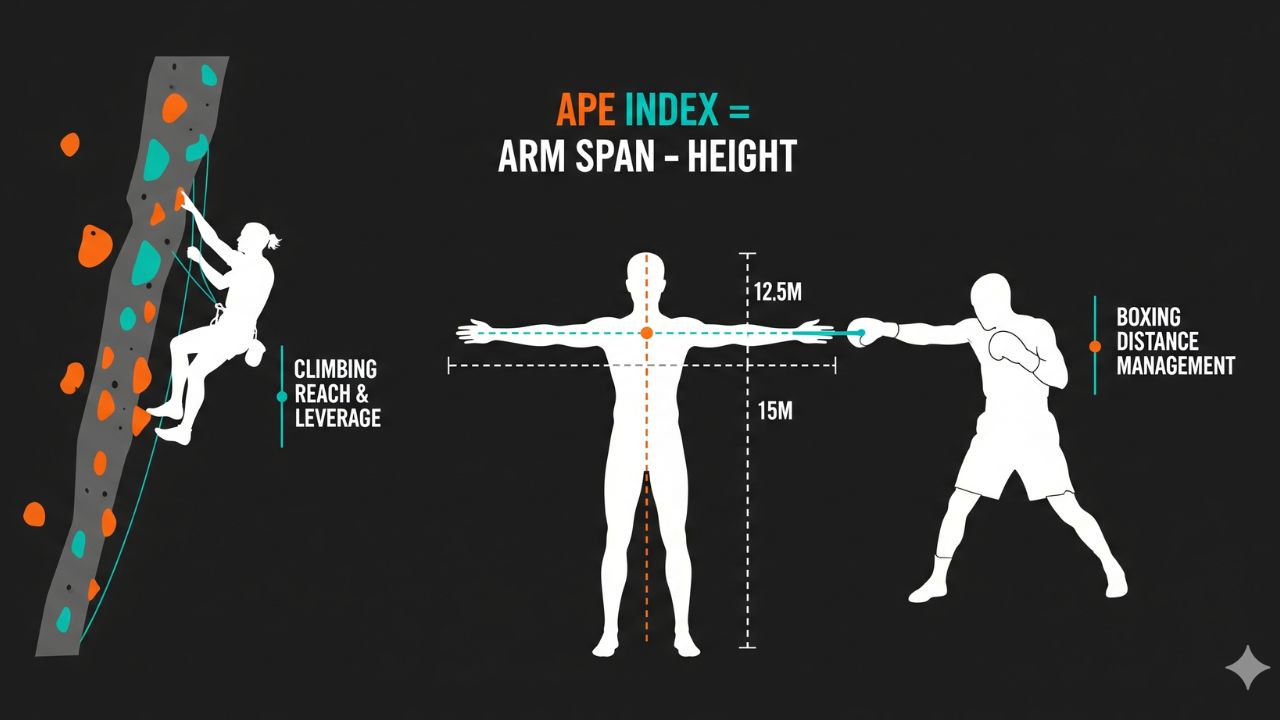
Anthropometry—the scientific study of the measurements and proportions of the human body—plays a critical role in athletic performance. Among the most widely analyzed anthropometric metrics in sports is the Ape Index. Originally popularized in the rock climbing community, the Ape Index is a measure of an individual’s arm span relative to their total height.
While the average human possesses a neutral index where arm span equals height, elite athletes across various disciplines often display extreme deviations. A positive index provides distinct biomechanical advantages in sports requiring reach, leverage, or wide defensive coverage, such as climbing, mixed martial arts, basketball, and swimming. Conversely, certain power-based sports favor a negative index.
Understanding the mathematics of the Ape Index and its impact on the physics of movement is essential for athletes looking to optimize their training and technique based on their genetic morphology.
The Mathematics and Calculation of the Ape Index
The Ape Index can be calculated and expressed using two primary mathematical models: the difference method and the ratio method. Both require precise measurements of total height ($H$) and total arm span ($S$), measured from fingertip to fingertip with arms fully abducted parallel to the floor.
1. The Difference Method
This is the most common calculation used in the climbing and combat sports communities. It is calculated by subtracting total height from total arm span. The resulting value is expressed in inches or centimeters, denoting a positive (+), neutral (0), or negative (-) index.$$\text{Ape Index}_{Diff} = S – H$$
If an athlete has an arm span of 74 inches and a height of 71 inches, the calculation is:$$\text{Ape Index}_{Diff} = 74 – 71 = +3 \text{ inches}$$
2. The Ratio Method
The ratio method is more commonly utilized in clinical biomechanics and advanced sports science. It divides the arm span by the height, providing a decimal coefficient.$$\text{Ape Index}_{Ratio} = \frac{S}{H}$$
Using the same measurements as above (74-inch span, 71-inch height):$$\text{Ape Index}_{Ratio} = \frac{74}{71} \approx 1.042$$
A ratio of exactly $1.00$ indicates a neutral index. A ratio greater than $1.00$ indicates a positive index, while a ratio less than $1.00$ indicates a negative index. The standard human average hovers tightly around a ratio of $1.00$ to $1.01$.
Read Also: What Is Anaerobic Threshold and Why Does It Matter?
The Ape Index in Rock Climbing and Bouldering
Nowhere is the Ape Index more fiercely debated than in rock climbing. The physical dimensions of a climber directly dictate how they interact with the rock face. A climber’s “box” refers to the maximum area they can reach while keeping their feet stationary. A higher Ape Index exponentially increases the volume of this box.
The Advantages of a Positive Index in Climbing
- Static Reach and Deadpointing: The most obvious advantage is the ability to reach holds that are further away. On routes set with wide wingspans in mind, a climber with a $+4$ index can simply reach out and grab a hold statically, whereas a climber with a negative index is forced to execute a low-percentage dynamic movement (a dyno or deadpoint) to cover the same distance.
- Resting Mechanics: Efficient climbing requires resting on the wall to clear lactic acid from the forearms. The most biomechanically efficient way to rest is hanging on a straight skeletal structure rather than maintaining isometric muscular contraction. Longer arms allow a climber to keep their hips lower and their center of gravity closer to the wall while maintaining straight arms on rests.
- High Feet and Flexibility Mitigation: A positive index often allows climbers to utilize lower, more comfortable footholds while still reaching the target handhold. This mitigates the need for extreme hip mobility and flexibility required to step up onto high footholds.
The Disadvantages and Physics of a Positive Index
A positive Ape Index is not a universal advantage; it introduces distinct mechanical penalties based on the laws of physics and torque.
- Leverage on Steep Walls: On overhanging walls, the body acts as a lever. Torque ($\tau$) is calculated as the cross product of the radius vector ($r$) and the force vector ($F$): $$\tau = r \times F$$ In climbing, longer arms mean a larger radius ($r$) between the point of contact (the hold) and the center of mass (the hips). This increased lever arm magnifies the rotational force pulling the climber off the wall. Climbers with long arms must possess significantly stronger core musculature (transversus abdominis and obliques) to counteract this torque and keep their feet on the wall.
- Lock-Off Strength: A “lock-off” occurs when a climber pulls their chin to their hand and holds that static, flexed-arm position to reach with the other hand. Longer arms require the bicep, brachialis, and latissimus dorsi to pull through a longer range of motion and hold a more disadvantageous mechanical angle. Climbers with shorter arms excel at deep lock-offs and tight, bunched movements.
Climbing Data Table: Notable Climbers and Anthropometry
| Climber | Discipline | Height | Arm Span | Ape Index (Difference) | Ape Index (Ratio) |
|---|---|---|---|---|---|
| Adam Ondra | Sport/Bouldering | 6’1″ (185 cm) | 6’2″ (188 cm) | +1 inch | 1.016 |
| Alex Honnold | Free Solo/Big Wall | 5’11” (180 cm) | 6’0″ (183 cm) | +1 inch | 1.014 |
| Lynn Hill | Trad/Free Climbing | 5’2″ (157 cm) | 5’3″ (160 cm) | +1 inch | 1.016 |
| Sean McColl | Competition | 5’6″ (168 cm) | 5’8″ (173 cm) | +2 inches | 1.030 |
| Rajat Sharma | Bouldering | 5’8″ (173 cm) | 5’11” (180 cm) | +3 inches | 1.040 |
The data reveals that while a positive index is common among elites, massive Ape Indices (e.g., $+4$ to $+6$) are not strictly mandatory for world-class performance. Technique, finger strength-to-weight ratio, and contact strength remain the dominant performance variables.
Read Also: What Is the Difference Between Leg Press and Squat Strength?
The Ape Index in Combat Sports: Boxing and MMA
In combat sports, the Ape Index is universally referred to as “reach.” A positive index provides an overwhelming tactical advantage when striking, heavily influencing distance management, defensive geometry, and offensive angles.
Distance Management and the Jab
A fighter with a superior Ape Index can land strikes on their opponent while remaining completely outside the opponent’s striking range. This is most evident in the application of the jab. By stepping into a jab, a fighter with a $+5$ Ape Index can disrupt the opponent’s rhythm, score points, and obscure the opponent’s vision without exposing their own chin to counter-strikes.
Defensive Geometry and Posting
Longer arms allow for more effective framing and posting. In mixed martial arts (MMA), when a fighter is defending a takedown or trying to stand up from the bottom position, posting a long arm on the opponent’s shoulder, hip, or head creates physical distance that shorter-armed fighters cannot easily close.
Data Table: Extreme Ape Indices in Combat Sports
| Fighter | Sport | Height | Arm Span (Reach) | Ape Index (Difference) |
|---|---|---|---|---|
| Jon Jones | MMA | 6’4″ (193 cm) | 7’0.5″ (215 cm) | +8.5 inches |
| Sonny Liston | Boxing | 6’1″ (185 cm) | 7’0″ (213 cm) | +11 inches |
| Conor McGregor | MMA | 5’9″ (175 cm) | 6’2″ (188 cm) | +5 inches |
| Max Holloway | MMA | 5’11” (180 cm) | 5’9″ (175 cm) | -2 inches |
Notice Max Holloway’s negative index. Fighters with negative or neutral indices must adapt by relying on high-volume inside boxing, exceptional footwork to bridge the gap rapidly, and overwhelming cardio.
The Ape Index in Swimming: The Hydrodynamic Lever
Swimming efficiency is dictated by hydrodynamics and the ability to generate maximum propulsion per stroke. A highly positive Ape Index is practically a prerequisite for Olympic-level swimming.
The arm acts as a paddle. The longer the arm, the longer the stroke length. A swimmer with a $+4$ Ape Index pulls more water per stroke cycle than a swimmer of the exact same height with a neutral index. Over the course of a 100-meter or 200-meter race, this allows the longer-armed swimmer to take fewer strokes, thereby conserving energy and maintaining a lower heart rate while traveling at the same velocity.
Michael Phelps is the ultimate case study in aquatic anthropometry. Standing at 6’4″ (193 cm), Phelps possesses an arm span of 6’7″ (201 cm), giving him an Ape Index of $+3$ inches. When combined with his disproportionately long torso and short legs, his body geometry drastically reduces drag coefficients in the water while maximizing the leverage of his pull.
The Ape Index in Basketball: Defensive Wingspan
In basketball, the term “wingspan” is synonymous with the Ape Index. NBA scouts highly prioritize draft prospects with positive indices, sometimes valuing wingspan over raw height.
A player who is 6’6″ with a 7’0″ wingspan (a massive $+6$ Ape Index) effectively defends like a 6’10” player. This morphological advantage manifests in several critical areas:
- Contesting Shots: Long arms allow defenders to alter the trajectory of a shooter’s release without having to jump as early or as high, keeping them grounded and less susceptible to pump fakes.
- Passing Lanes: A wider arm span geometrically shrinks the available passing lanes on the court, increasing the probability of deflections and steals.
- Rebounding: The apex of a player’s standing reach is determined by height plus arm length. A high positive index allows players to secure rebounds over taller opponents who possess neutral or negative indices.
Kawhi Leonard (Height 6’7″, Wingspan 7’3″, Ape Index $+8$) and Rajon Rondo (Height 6’1″, Wingspan 6’9″, Ape Index $+8$) are prime examples of players whose elite defensive capabilities are heavily amplified by their extreme Ape Indices.
Read Also: How to Choose a Realistic Goal for Your First 10K
The Ape Index in Powerlifting and Weightlifting
While climbing, fighting, swimming, and basketball reward a positive index, the sport of powerlifting provides a fascinating dichotomy where the optimal Ape Index depends entirely on the specific lift being performed. This is governed by the physics of mechanical work.
The formula for physical Work ($W$) is Force ($F$) multiplied by Distance ($d$):$$W = F \times d$$
In powerlifting, the goal is to move the maximum amount of weight (Force) while minimizing the Distance the bar has to travel.
The Bench Press: The Negative Index Advantage
In the bench press, the bar must travel from full arm extension down to the chest and back up to extension. A lifter with a highly positive Ape Index has to push the bar over a significantly longer distance ($d$). Furthermore, long arms create a longer lever arm from the elbow to the shoulder, increasing the torque on the shoulder joint and requiring more force from the pectorals and triceps to move the same weight.
Therefore, a negative Ape Index (short arms, barrel chest) is a massive biomechanical advantage in the bench press, effectively minimizing the range of motion.
The Deadlift: The Positive Index Advantage
Conversely, the deadlift strongly favors a positive Ape Index. In a conventional deadlift, the lifter must pull the bar from the floor to full hip extension.
Long arms effectively reduce the distance the lifter has to pull the bar. More importantly, long arms allow the lifter to start the movement with a more upright torso angle. This decreases the mechanical torque placed on the lumbar spine and allows the lifter to utilize their powerful glutes and hamstrings earlier in the pull. A lifter with short arms (negative index) is forced to hinge their torso almost parallel to the floor, placing immense strain on the lower back and creating an inefficient, lengthened pull.
How to Train Around Your Ape Index
Athletes cannot alter their skeletal structure, but they can tailor their training and technique to capitalize on their morphology or mitigate its drawbacks.
Strategies for a Negative or Neutral Ape Index:
- Develop Explosive Power: In climbing, if you cannot reach a hold statically, you must generate momentum. Plyometric training and dynamic movement practice (dynos, deadpoints) are essential.
- Maximize Flexibility: A negative index climber must rely on exceptionally high foot placements to bring their hips closer to the target handhold. Daily hip, hamstring, and ankle mobility work is non-negotiable.
- Inside Fighting Techniques: In combat sports, shorter-armed fighters must master head movement (slips and rolls) to safely cross the “kill zone” and fight effectively on the inside using hooks and uppercuts.
Strategies for a Highly Positive Ape Index:
- Prioritize Core Stability: The longer the lever, the greater the rotational force. Climbers with a $+4$ index or greater must engage in rigorous anti-rotation core training (e.g., Pallof presses, front levers) to prevent their feet from swinging off the wall when fully extended.
- Develop Lock-Off Strength: Long arms are weak in deep flexion. Bouldering often forces climbers into tight, bunched positions. Targeted isometric bicep and latissimus training (e.g., Frenchies, weighted pull-up holds) will help overcome the mechanical disadvantage of long levers in tight spaces.
- Master the Jab: In combat sports, the jab is the primary weapon for utilizing a reach advantage. A fighter with a positive index should dedicate significant training volume to developing a stiff, fast, and varied jab to control the pace and distance of the fight.
Summary
The Ape Index is a profound biometric marker that significantly influences mechanical efficiency across athletic disciplines. While a positive index provides distinct advantages in sports prioritizing reach, coverage, and stroke length, it also introduces specific biomechanical penalties, such as increased torque on joints and longer ranges of motion in pressing movements.
Ultimately, morphology is a physical baseline. While athletes like Michael Phelps and Jon Jones possess genetic anomalies that complement their sports, athletes with average or negative indices routinely reach elite status through superior technique, specialized strength and conditioning, and a deep understanding of their own biomechanical leverage.